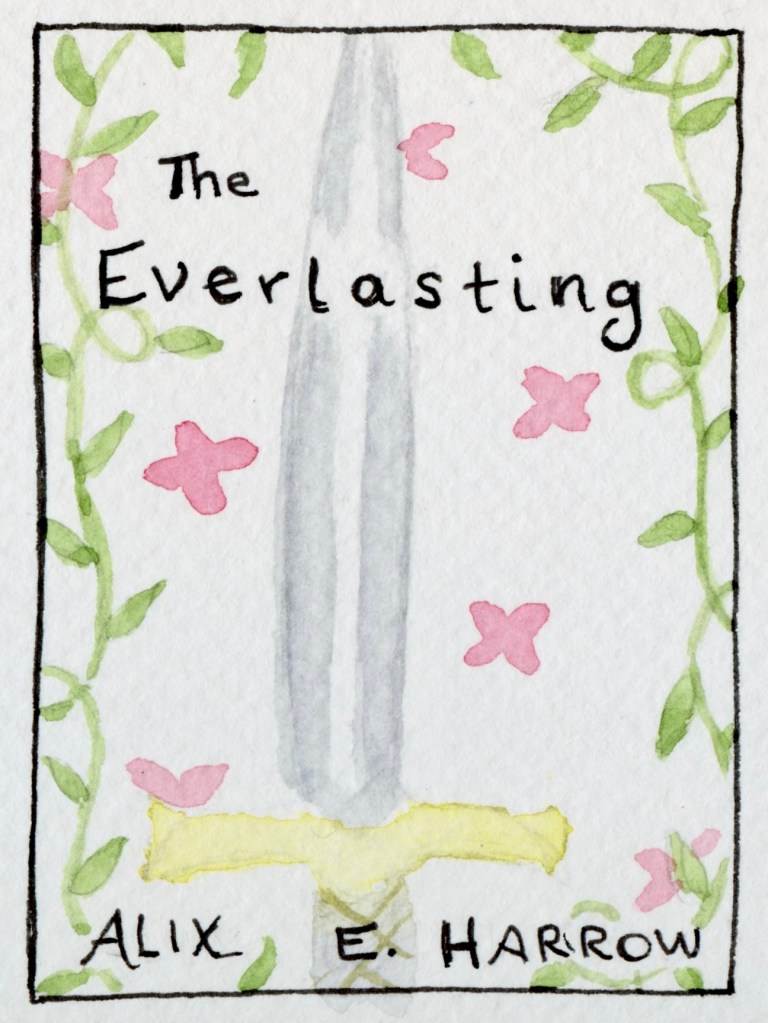
The Everlasting
by Alix E. Harrow, published 2025
Owen Mallory is an academic who lives in a kingdom called Dominion, eking out an existence after fighting in one of Dominion’s many wars, and is a nobody in a university history department.
He is obsessed with the legend of Sir Una Everlasting, the mythical(?) female knight who helped the first Queen of Dominion establish the country. One day he receives a book with the oldest version of the legend yet, and is tasked with translating it.
He then finds himself traveling back through the book in time, to meet Una and write her story. He discovers the person behind the myth, falls in love, watches her die, works on his translation, and travels back again and again and again.
While this is not exactly an Arthurian legend book, it also is sort of a gender-swapped Arthur (ahem, our protagonist’s name is Mallory, wink). The time travel and repeating history aspect is interesting, and I was rooting for Owen and Una. I enjoyed the way the time travel allowed the book to play with both real people living their lives and also historical record and the way that mythology (and sometimes also history) sands off the rough edges and those writing the history can tweak the story to fit a narrative that serves them.
I left the book thinking about history and legend and national stories. America is a country that is less of an ethnic identity (no matter what some politicians will tell you), and more of an idea, a creed, a set of beliefs (see the Declaration of Independence and Frederick Douglass’s 4th of July speech for examples). The story we tell about ourselves and our national identity is important, and yet it is easy to only tell part of the truth about anything, to collapse the complicated truth to something simpler.
Anyway, this is all to say that I enjoyed this book.
Content: violence (because Sir Una is essentially a medieval knight), sex, language, death
Make Believe
By Marc Barnett, published 2026
“Maybe more like 94.7% of kids’ books are crud. And that’s because kids’ books, unlike most writing, are made by people (adults) who are not members of their intended audience (kids). And children are in so many ways different from adults, though often not in the ways adults expect.”
This small book was engaging, funny, and had a very definite point of view on children’s literature. My bookshop colleague led a discussion on it, which was a delight.
Barnett thinks the best children’s book authors either have a lot of empathy with children, have a direct line back to their own childhood, or both.
I will be thinking for a while about the ways the many children’s books are trying to Teach A Lesson and how this is often prioritized over just telling good stories that children would enjoy. Someone in the discussion said that many authors (of novels for grown-ups) are so busy working out their own stuff that they do not seem to care about their audience. This led to talking about authors whom we trust to handle material in a way that cares for their audience. Are there authors in whose hands you feel safe? Bad things may happen to the characters in their books, but they still have care for them and for you?
I want this reading experience for both children and adults, and I agree with Barnett that we ought to take much more care in putting out books for children that try to tell good stories and take children seriously as humans.
Discover more from Austin Fey
Subscribe to get the latest posts sent to your email.
