The Magician’s Nephew
by C. S. Lewis, published 1955
Two children are sent to another world by magic. They witness the creation of the land of Narnia, where animals can talk and the great lion Aslan watches over its fate. A lovely creation myth. While this is the first in the Chronicles of Narnia chronologically, it is really a prequel and not the best introduction to the series.
Because I was listening to the audio book, I listened in chronological order but I will die (maybe not literally?) on the hill that for first-time readers you really should start with the first published book, The Lion, the Witch and the Wardrobe.
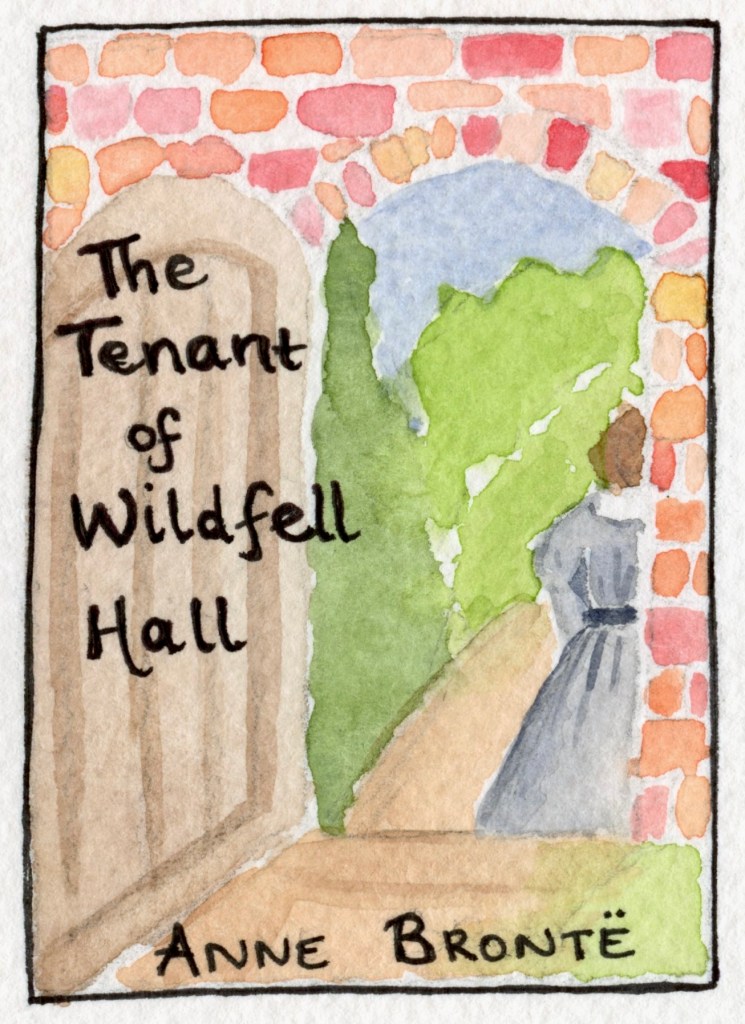
The Tenant of Wildfell Hall
by Anne Brontë, published 1848
The final installment in my Brontë book club! Don’t sleep on this one: it is such an interesting exploration of marriage and female interior life (for the upper middle class anyway) in 19th century England.
The structure of this is interesting: it starts as a letter from a young man, Gilbert Markham, to his brother-in-law, looking back on when he met the titular tenant. We then transition to Helen (said tenant) and hear about her life from her diaries, which she shares with Gilbert.
Helen is an early “I can fix him!” girl. She married a young man who was young, exciting, and attractive (as opposed to the old, boring, but wealthy men with whom her aunt tries to set her up). However, she discovers that when it comes to character and virtue, these attributes are important and non-transferable.
She perseveres, but for the sake of her young son, whom she does not want to see corrupted, she decides she needs to leave. Women in the 19th century did not have rights to their own property or children, so she needs to flee in secret and go into hiding.
This is an exploration of relationships, moral character (and lack thereof), and is (as someone pointed out in our book club) more of a story of manners a la Jane Austen (though tonally quite different) than either Wuthering Heights or Jane Eyre. We get a glimpse of a section of society and the ways that humans fail or help each other.
The Lion, the Witch and the Wardrobe
by C. S. Lewis, published 1950
The proper introduction to Narnia, a magical world that certainly captured my imagination as a child. Lewis is a good storyteller, and I enjoyed wandering back into that world.
Lucy walks through a wardrobe into the land of Narnia, where she and her siblings are immediately drawn into a power struggle for the fate of this magical world. Features poor choices in desserts, the most charming beaver couple, and descriptions that make you long to walk through a wardrobe yourself to visit a magical place.
This might be my favorite of the Narnia books? I’ll check back in on that once I finish them all.
The Horse and His Boy
by C. S. Lewis, published 1954
Two children and two talking horses set off on an escape to Narnia. Chases, disguises, mistaken identities, and fighting ensues. While there are Eastern stereotypes at play that don’t all age well, this is still a great adventure tale.
Might start addressing my Mom like the Calormen do: “Oh my mother and oh the delight of my eyes….” Should have made that my Mother’s Day greeting. Maybe next year.