Ethan Frome
By Edith Wharton, published 1911
“‘That man touch a hundred? He looks as if he was dead and in hell now!’
“Harmon drew a slab of tobacco from his pocket and cut off a wedge and pressed it into the leather pouch of his cheek. ‘Guess he’s been in Starkfield too many winters. Most of the smart ones got away.’
“‘Why didn’t he?’”
This is if the proverb “marry in haste, repent at leisure” was a novella. It is elegantly spare and short, and honestly, more words would make it more melodramatic and not improve the story. It feels a bit like a thriller: the creeping dread of the frozen winter landscape, Zeena’s ominous silences, the difficult financial situation closing in on Ethan, etc.
People cope with unhappiness in different ways, and you know from the outset that this story is going to be tragic, but it’s hard to look away. Wharton unspools the story so you want to know what will happen with these people, even though you are sure the ending won’t be happy.
This one will stick with you, and while it is tragic, it is also so well written.
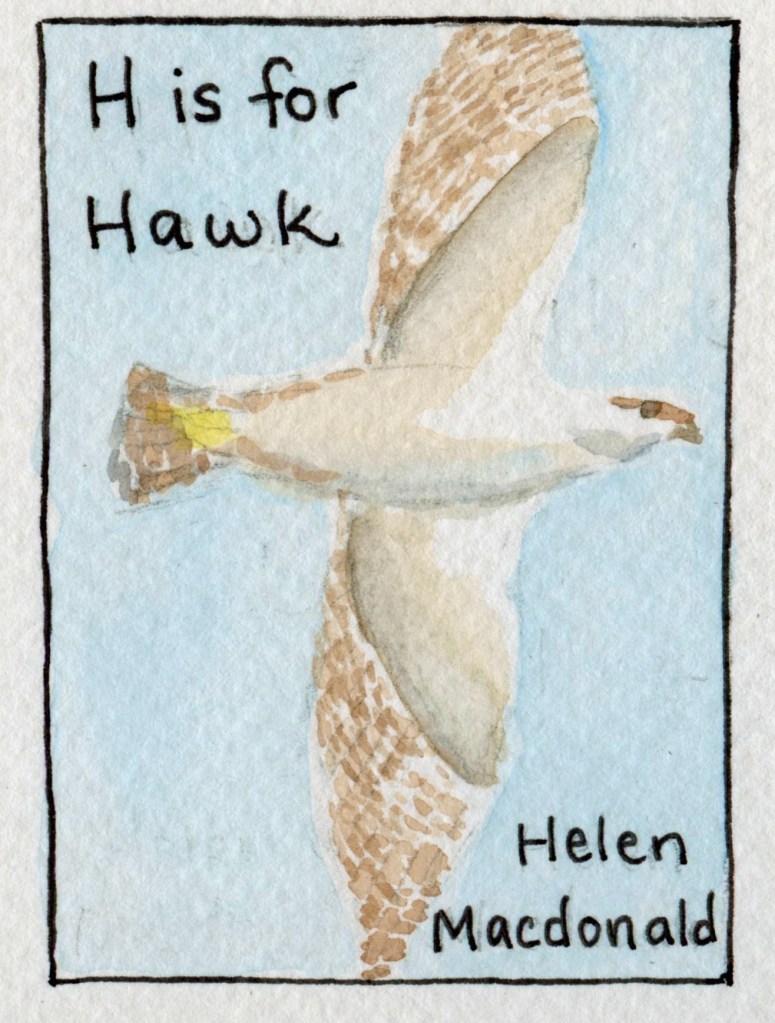
H is for Hawk
By Helen Macdonald, published 2014
“The man pulls an enormous, enormous hawk out of the box and in a strange coincidence of world and deed a great flood of sunlight drenches us and everything is brilliance and fury. The hawk’s wings, barred and beating, the sharp fingers of her dark-tipped primaries cutting the air, her feathers raised like the scattered quills of a fretful porpentine. Two enormous eyes. My heart jumps sideways. She is a conjuring trick. A reptile. A fallen angel. A griffon from the pages of an illuminated bestiary. Something bright and distant, like gold falling through water. A broken marionette of wings, legs and light-splashed feathers.”
This book weaves three strands together: a memoir of grief after the sudden death of the author’s father, nature writing about falconry, and a partial biography of T. H. White.
You might not think these would mix well, but in Macdonald’s hands they do. Her journey of grief therapy via falconry and White’s are parallel in interesting ways, and having a way to work through grief is important. The way she describes losing herself in the process of training her goshawk, Mabel, is so real and raw. Retreating from civilized and oppressive humanity and into the wildness of her predator hawk makes sense as a coping mechanism when the grief is too much. Everyone grieves in their own way, and Macdonald is generous in describing hers and White’s. The nature-writing descriptions of flying her hawk are also so lovely and vivid.
The pace is deliberate, and I read it slowly, which I think helped me get through it–a memoir of grief can remind you of all your own griefs, which is sometimes helpful and sometimes painful. While we feel alone in grief (and that is on display in this book), grief is also common to all, and that is recognizable here.
