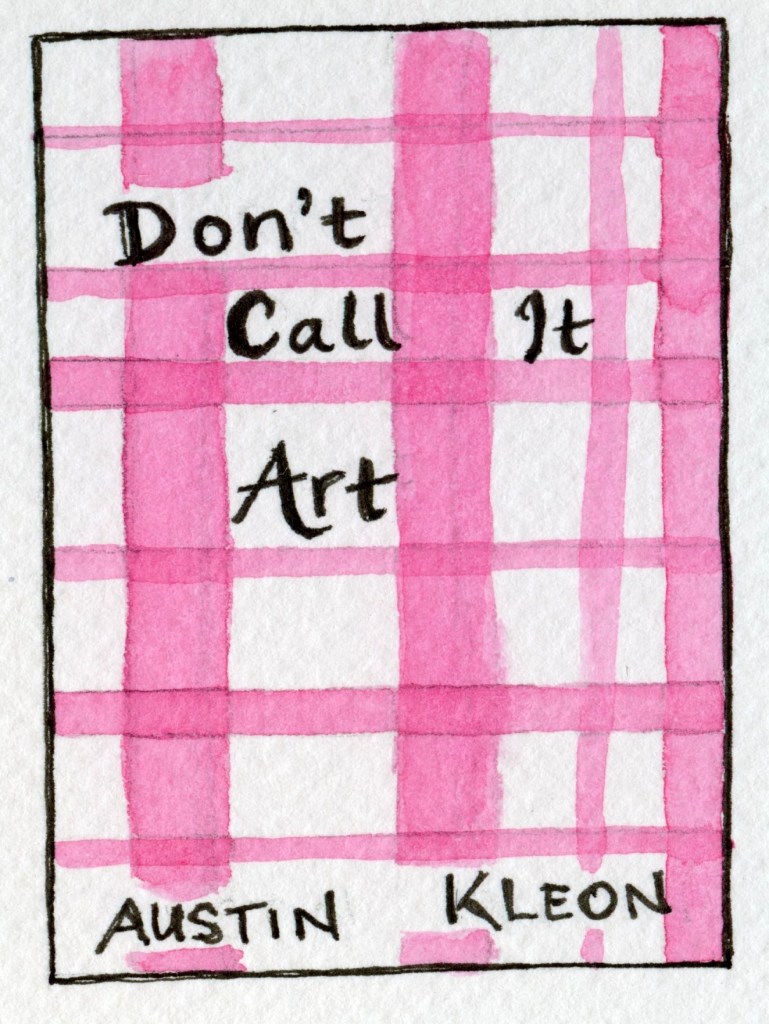
Don’t Call It Art
By Austin Kleon, published 2026
“To waste time in the modern world is considered the greatest of sins, and idleness is looked upon with suspicion. To be thought of as productive, one needs to look busy. But you will not always look busy when you’re being creative. In fact, if you check in on creative people at different moments in the day, it will look like they are doing absolutely nothing, or doing the kinds of things kids get yelled at for in the classroom….”
Austin Kleon’s little books are encouraging and fun. They are meant to help you continue in creative practices with a combination of advice, humor, quotes, and stories from Kleon’s own creative life. They are also best experienced by reading the books themselves to see the drawings and illustrations.
This installment has a lot of reflections about art and his children, drawn from being an “art assistant” to them and remembering what it was like to create with the artistic freedom of a child whose inner critic has not yet developed into crippling insecurity.
“The artist ventures into the unknown, making and doing things that no one has ever seen before.” Love it. Let’s go make some stuff! …But you don’t have to call it art. Just mess around and make something (a good word for a recovering perfectionist like me).
North Woods
By Daniel Mason, published 2023
This is a story about a particular yellow house in the—you guessed it—north woods of Massachusetts. The house is built by a young couple fleeing their town, and each section is a vignette of someone who lives in the house.
The stories, though separate, start to converge in strange ways, the past affecting the present. The house is the only through line; though whispers of past inhabitants continue, sometimes through their decisions, sometimes as ghosts, and the house itself is unsettling to some.
This was an interesting and weird book, as a result of the structure (following the house, not the characters). Some of the stories felt a little too much, and I think it would have been a stronger book if it was a little bit shorter. While I enjoyed it, I was ready to be done before the author was ready to be done, though I know not everyone had that reaction. Mason was clearly having a great time writing the vignettes and deciding where to go next though, and that came across to me reading it. I appreciated the ambition of following a place, not a person, even if I did not find it completely successful in paying off its promise.
DNF (Did Not Finish) Pile
Yesteryear
By Caro Claire Burke published 2026
This is an extremely polarizing book. While I loved the premise, I found the characters unconvincing and decided I’d rather just have conversations with people about tradwife influencers and Mom-culture than read the rest of this book. I think the execution didn’t line up with my expectations, and that was part of the problem (I expected an unlikeable narrator, but I found her a little…boring).
Since I didn’t finish the book it’s a bit of a cheat to write something about it, but I decided the book wasn’t for me even though I appreciated what Burke was trying to do and I find the discourse around it fascinating. I also wonder about the staying power of this book. It is everywhere this summer, but I’m curious if this is the type of book that is for this specific moment and then will fade, or if it will have a longer shelf-life.