Books Read in June 2026, Part 1

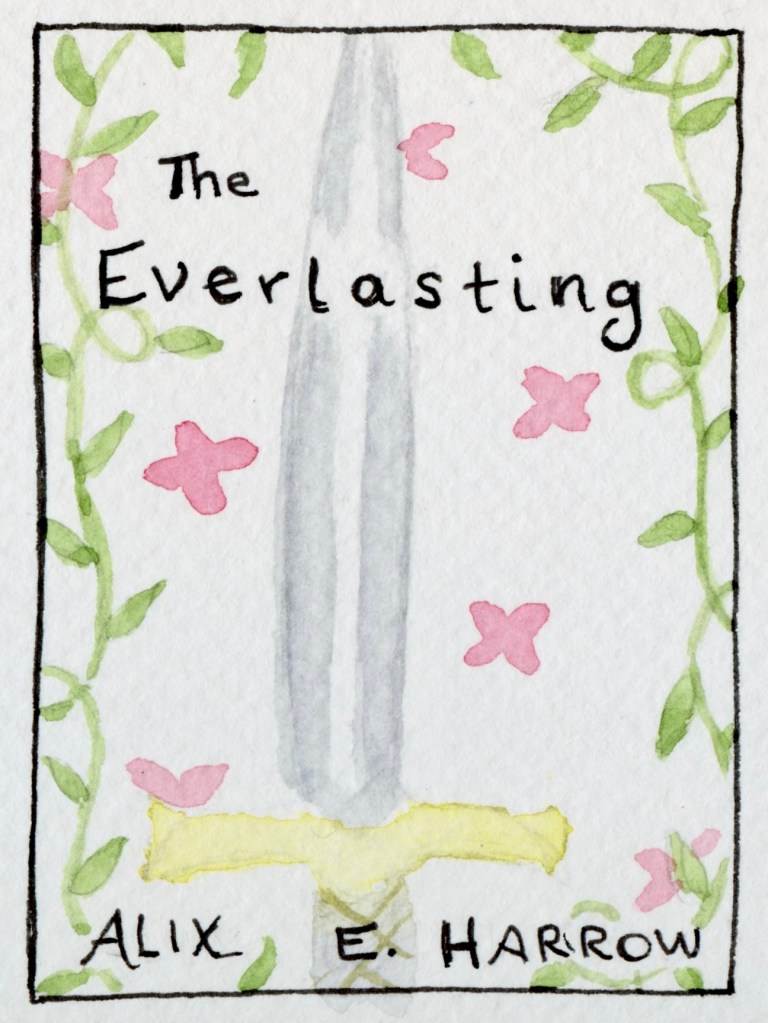
The Everlasting

by Alix E. Harrow, published 2025

Owen Mallory is an academic who lives in a kingdom called Dominion, eking out an existence after fighting in one of Dominion’s many wars, and is a nobody in a university history department. 

He is obsessed with the legend of Sir Una Everlasting, the mythical(?) female knight who helped the first Queen of Dominion establish the country. One day he receives a book with the oldest version of the legend yet, and is tasked with translating it. 

He then finds himself traveling back through the book in time, to meet Una and write her story. He discovers the person behind the myth, falls in love, watches her die, works on his translation, and travels back again and again and again. 

While this is not exactly an Arthurian legend book, it also is sort of a gender-swapped Arthur (ahem, our protagonist’s name is Mallory, wink). The time travel and repeating history aspect is interesting, and I was rooting for Owen and Una. I enjoyed the way the time travel allowed the book to play with both real people living their lives and also historical record and the way that mythology (and sometimes also history) sands off the rough edges and those writing the history can tweak the story to fit a narrative that serves them. 

I left the book thinking about history and legend and national stories. America is a country that is less of an ethnic identity (no matter what some politicians will tell you), and more of an idea, a creed, a set of beliefs (see the Declaration of Independence and Frederick Douglass’s 4th of July speech for examples). The story we tell about ourselves and our national identity is important, and yet it is easy to only tell part of the truth about anything, to collapse the complicated truth to something simpler. 

Anyway, this is all to say that I enjoyed this book. 

Content: violence (because Sir Una is essentially a medieval knight), sex, language, death
Make Believe 

By Marc Barnett, published 2026

“Maybe more like 94.7% of kids’ books are crud. And that’s because kids’ books, unlike most writing, are made by people (adults) who are not members of their intended audience (kids). And children are in so many ways different from adults, though often not in the ways adults expect.” 

This small book was engaging, funny, and had a very definite point of view on children’s literature. My bookshop colleague led a discussion on it, which was a delight. 

Barnett thinks the best children’s book authors either have a lot of empathy with children, have a direct line back to their own childhood, or both. 

I will be thinking for a while about the ways the many children’s books are trying to Teach A Lesson and how this is often prioritized over just telling good stories that children would enjoy. Someone in the discussion said that many authors (of novels for grown-ups) are so busy working out their own stuff that they do not seem to care about their audience. This led to talking about authors whom we trust to handle material in a way that cares for their audience. Are there authors in whose hands you feel safe? Bad things may happen to the characters in their books, but they still have care for them and for you? 

I want this reading experience for both children and adults, and I agree with Barnett that we ought to take much more care in putting out books for children that try to tell good stories and take children seriously as humans. 

Books Read in February 2025

I’ve been putting off publishing this because I started painting the upstairs walls (and ceilings and doors and trim) and did not have an office space to paint my little book covers. However, it is now mid-April, and really it’s best to just move forward and return to cute little book covers later. Sorry, February! But here is what I read:

The Two Towers, by J.R.R. Tolkien

Tolkien’s story of an epic quest to rid Middle Earth of an evil via a magic ring continues in The Two Towers. 

The fellowship of nine companions who set out to destroy the ring of power have been scattered, and the first half of the book follows most of our heroes as they cover new ground and the second half follows the other two as they continue the journey to the land of Mordor and the volcano where the ring can be destroyed. 

The second installment of a series often expands the world, introduces new characters, and splits up the party to follow various side quests.

Tolkien split his story into 6 sub-books, and I had forgotten that the entirety of “book three” (the first half of The Two Towers) is about the rest of the fellowship and the entirety of “book four” is about Frodo and Sam. I wish Tolkien had organized the book to interweave the two stories a bit more, as there’s a lot of excitement (and a battle!) in the first half, and then the action nearly grinds to a halt as we follow the two hobbits’ slow journey in the second half. One almost forgets all the activity as the journey to Mordor creeps onward. 

I do think the slowness of the journey to Mordor highlights its difficulty; the brutal terrain, the enemies all around, and the burden of the ring growing. It is effective in communicating that doing what is right is often difficult, tedious, and part of Frodo’s heroism is continuing even when he thinks the chance of success grows smaller every day. 

While I would have suggested interweaving the stories a bit more so we didn’t forget about one half of the adventure while following the other, Tolkien is still a good storyteller and the world he created becomes more incredible as the view of it expands. I love meeting new characters (one of whom is female—hooray). 

As with The Fellowship of the Ring, I listened to Andy Serkis’s narration of the audiobook, and I have no idea how he kept all the different character voices straight, but his commitment to the book was impressive and entertaining. 

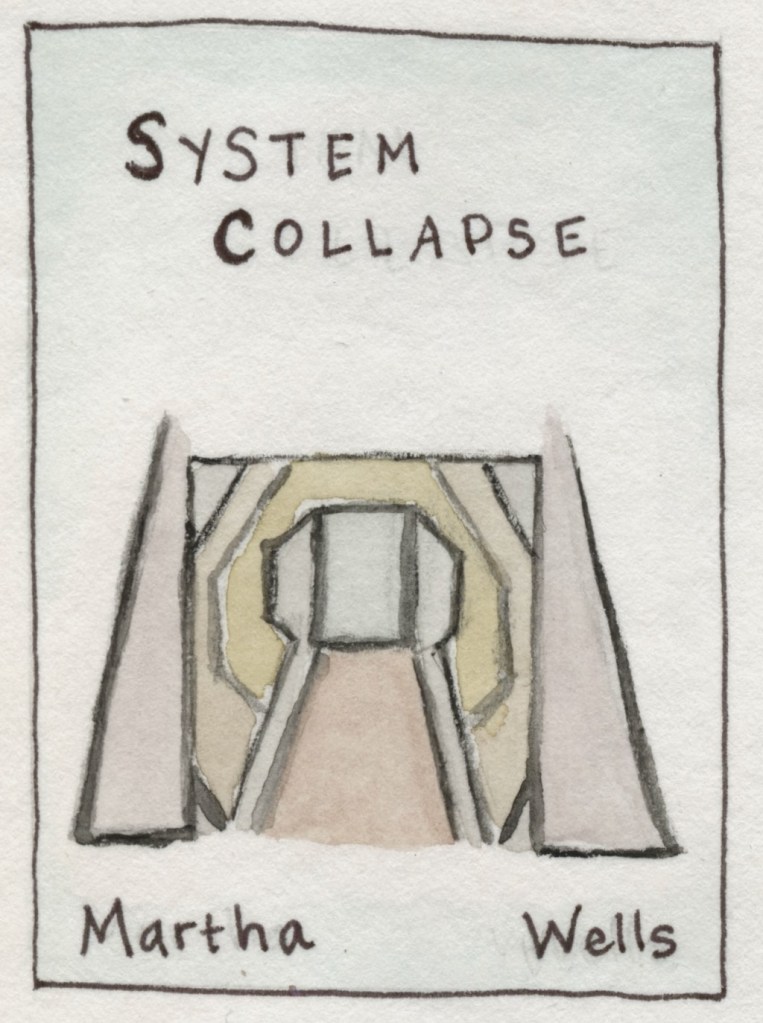
System Collapse, by Martha Wells

Murderbot returns for more adventures! 

It is difficult to write reviews for subsequent books in a series due to spoilers for previous books, and also just the difficulty in dropping someone in when an adventure is seven books deep. 

The Murderbot Diaries series follows a cyborg Security Unit that has hacked its governor module (which compelled it to follow orders) and has gone rogue. The SecUnit has christened itself “Murderbot” and is trying to figure itself out over the course of the series. 

This installment picks up immediately following the last adventure, so it is helpful to refresh one’s memory about recent events via a Wikipedia entry of plot summaries if one has forgotten exactly what happened last. 

Murderbot is snarky, and swings between being extremely concerned about the safety of its adopted humans and wanting to be left online to watch tv. Relatable. In each adventure Murderbot is also learning more about itself and also reluctantly forming relationships with some kind humans and another snarky bot, ART (who is a transport ship—don’t think too hard about how that works). 

There’s a lot of plot and action, and most of the books are novellas, but the threads of self-discovery and growth that run throughout are really charming. I enjoy plot-heavy books, so I enjoy the action in these, but I also want characters to learn and grow over time, and Murderbot does grow through its experiences and is changed by interactions with others. Wanting to just sit around and watch tv but instead going out and forming relationships, caring for others in the best way it knows how (calculating the probability of everything falling apart and its humans reaching untimely ends unless Murderbot intervenes) is actually quite lovely. 

While there is one full-length novel in the series, I really think these stories work better as novellas, and was pleased to see this return to form. 

The Return of the King, by J.R.R. Tolkien

Tolkien’s epic fantasy trilogy comes to a conclusion at last! 

Once again, the first part of the book is devoted to Aragorn & co. and the second part follows Frodo and Sam on the final stage of their journey through Mordor to rid the world of Sauron’s evil ring which holds his power and keeps his malice alive.

Eventually the two stories converge, but the two journeys are mostly separate once again. 

Tolkien’s descriptions of the natural world are beautiful (or depressing, when he describes what evil characters do to nature when they have power over it; you know a character is evil if he cuts down trees for no reason). The descriptions at the end of rebuilding, with planting trees, an abundant harvest and the births of many children as signs of renewal and restoration, peace and plenty, are so lovely. 

Some people have complained that the denouement goes on too long, but I love that the members of the fellowship take their time disbanding after their time together, and I enjoyed the chapter The Scouring of the Shire about how evil can spread even to places we once thought “safe.” Also, it’s one final adventure for our hobbits on their own, and it shows how much they have learned and grown from their adventures in the wider world. 

The ending is bittersweet and hopeful—a reminder that journeys and wars leave scars, but also that there is healing and leaving a place better than you found it is a worthy goal, whether or not you personally get to enjoy the peace and prosperity. 

It has been such a delight revisiting Middle Earth! There are so many great characters, a beautiful world, and resonant themes that it is no wonder this trilogy is a fantasy classic and has inspired so many people to follow in Tolkien’s footsteps.

“There, peeping among the cloud-wrack above a dark tor high up in the mountains, Sam saw a white star twinkle for a while. The beauty of it smote his heart, as he looked up out of the forsaken land, and hope returned to him. For like a shaft, clear and cold, the thought pierced him that in the end the Shadow was only a small and passing thing: there was light and high beauty for ever beyond its reach.”