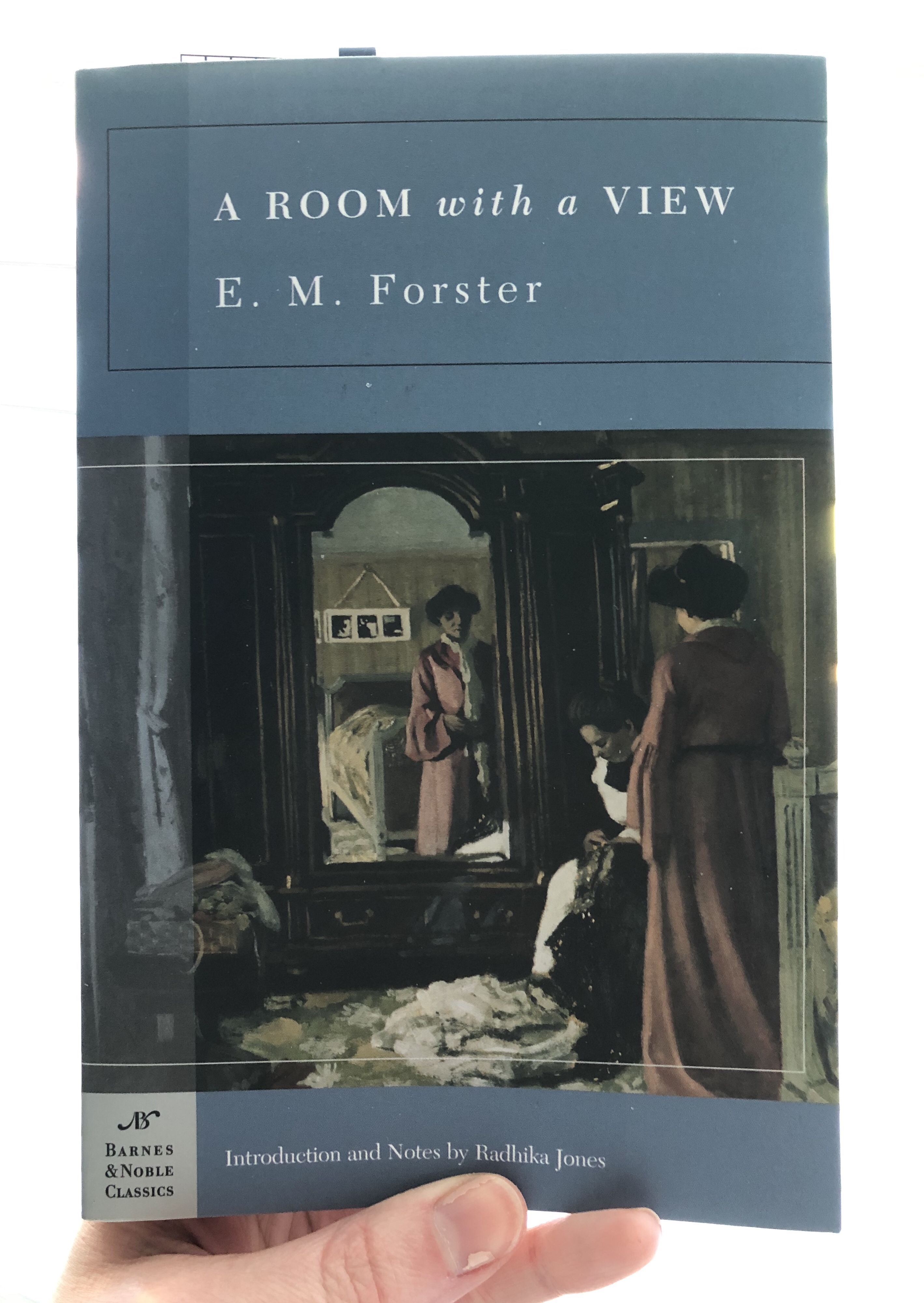
A Room with a View

I. Lucy Honeychurch and her cousin companion, Miss Charlotte Bartlett, travel to Italy where they stay in a British pension with other Brits and want to properly appreciate the sights with other proper tourists. There they meet the Emersons, a father and son who are more free spirited, and thus viewed with mild suspicion by the other tourists. Lucy likes them, though she’s torn between her feelings and her sense of what proper, refined people think and believe. These warring desires are brought to a head by a Slightly Dramatic Event (these are Edwardians, after all; we can’t get too crazy here)….

II. Back in England after her adventure, Lucy has one more chance to decide whether she wants a life based on Societal Expectations (her fiance is a too stuffy for even her own family) or whether she’ll follow desires she’s pushed deep down.

The book meditates on the difference between desires and expectations, and also highlights how in Proper society, emotion is a hindrance and ought to be repressed.

Lucy’s perception of what her family wants and expects is not exactly what they do want for her, and she gets tangled up in her mind trying to fulfill expectations that actually bore her. Her deep desires aren’t even to be a rebel, they just aren’t to be a stuffy society lady, which is what she thinks she ought to want.

I enjoyed this book and recommend it as it is a pretty slim classic, and it’s not a difficult read.

There’s also an excellent 1986 film version with a tiny Helena Bonham-Carter as Lucy. The pace is deliberate, but I think it captures the spirit of the book well; the acting is excellent (Judi Dench! Maggie Smith! Daniel Day-Lewis as THE stuffiest British person you can imagine!) and allows the story to unfold.

★ ★ ★ ★

Next On the List – Classics Club Spin 24

It’s been so long since I’ve updated here; it was hard to read and focus at the beginning of the pandemic, and while that’s still somewhat the case, human beings are fairly adaptable, and I’ve been able to read a few books over the past couple months. I’ll post separately about what I read the past few months. On to what I’m reading next!

The Classics Club is doing another “spin,” which is basically where you make a list of books you’re thinking about reading next from your list, number them, and they choose a number. That chooses the next book for you. As I’m being indecisive about what classic to pick next, this is perfect. Here’s my list:

  1. Pride & Prejudice, by Jane Austen
  2. The Pickwick Papers, by Charles Dickens
  3. A Prayer for Owen Meany, by John Irving
  4. The Spy Who Came In From the Cold, by John le Carre
  5. Many Waters, by Madeline L’Engle
  6. An Acceptable Time, by Madeline L’Engle
  7. Gaudy Night, by Dorothy Sayers
  8. Barchester Towers, by Anthony Trollope
  9. Richard II, by William Shakespeare
  10. Meditations, by Marcus Aurelius
  11. Emma, by Jane Austen
  12. The Pickwick Papers, by Charles Dickens
  13. A Prayer for Owen Meany, by John Irving
  14. The Spy Who Came In From the Cold, by John le Carre
  15. Many Waters, by Madeline L’Engle
  16. An Acceptable Time, by Madeline L’Engle
  17. Gaudy Night, by Dorothy Sayers
  18. Barchester Towers, by Anthony Trollope
  19. Richard II, by William Shakespeare
  20. Meditations, by Marcus Aurelius

Yes, I know I listed most of these twice. I have enough books on my classics list to fill the slots, but I’m not ready to dive into a Russian classic just yet (it’s not cold enough!), so this is my list. There are some perks to being an adult and making up some of my own rules….

Update: I’ll be reading #18, Barchester Towers, next. I’m trying to decide if I want to read the physical book or listen to an audiobook version. To be determined (advice welcome)!

The Woman in White

I read this for my 50 Classics project and also for the Genre Classic in the “Back to the Classics” challenge.

It’s supposed to be one of the first “mystery” novels. It’s kind of like Charles Dickens writing a mystery–there’s a lot of ramp up as it slowly builds the picture of what’s going on.

Overall, I enjoyed it, but it was definitely slow moving, especially at first. The novel is written from several first-person perspectives, but the primary protagonist is Walter Hartright, an artist and drawing master who becomes connected with the Fairlie family when he’s employed to teach drawing to two half-sisters, Laura Fairlie and Marian Halcombe.

Marian is described as dark haired and eyed and “man-like” in her firm mind and stout heart (also, Collins tells us, she doesn’t wear corsets). Laura, meanwhile, has light hair and eyes and is much more emotionally and physically frail. One assumes she does wear corsets. Obviously, this being a 19th century work, Walter falls for Laura…cue eyeroll. But alas! Laura is engaged to Sir Percival Glyde (what a name!) and Walter quits his job and goes abroad to forget her.

Most of the book centers around Sir Percival’s nefarious plot to get Laura’s money, which he’s limited in drawing from because of a well-written Trust (competent estate planning for the win!). Laura soon discovers her husband and his Italian friend, Count Fosco, are after her money, and the reader begins to fear for her safety.

I don’t want to spoil everything, but there are two lookalike women, the fortune-hunting unscrupulous spouse, a shady foreigner, a mysterious death, and a cranky invalid uncle who is too ill to deal with your bullying ways…fetch my smelling salts!

Things did pick up at the end, and while a good editor might have improved the pacing, it wasn’t bad for an early mystery. Just don’t expect a Holmes-style sleuth–the genre had not yet advanced to that stage, and if you have time and want to settle in, this is an enjoyable read.

★ ★ ★ ★

The Picture of Dorian Gray

I’m counting this both for my 50 Classics project and for the Back to the Classics challenge it’s an “Abandoned Classic” because I started it about 10 years ago, put it down, and never returned (until now).

Dorian Gray is a very attractive young man who is rather vain and selfish, but his money and good looks gain him entry into London society. He’s easily influenced by a friend, Sir Henry Wotton, who espouses complete hedonism (and only partially follows through as he prefers listening to himself speak than taking action).

Basil Hallward, an artist, paints a stunning portrait of his muse, Dorian, and Dorian is sad that he will age while his portrait remains ageless…. He wishes he could exchange places and the portrait age while he remains youthful and *boom* wish granted.

This book is billed as a classic, and I have never seen it on the sci fi/ fantasy shelf, but it could be shelved there. While it’s rooted in the daily life of a handsome rich man, it’s about a man who doesn’t age because his portrait does instead! While his friends do comment on his “maintaining his looks” you’d think they would notice that he still looks 20 when he’s really 38? But perhaps in an age before selfies it wasn’t as obvious. And maybe they just assumed he spent a lot of his money on beauty treatments.

Dorian uses his agelessness as license to do whatever he wants. He can be dramatic and occasionally he thinks about making good choices, but ultimately he doesn’t have the grit to follow through on anything that doesn’t yield immediate gratification. “The only way to get rid of temptation is to yield to it,” says Sir Henry, and Dorian takes that to heart.

The book explores how people judge based on money and beauty, and the fruits of selfishness. This was particularly interesting to read right after A Gentleman in Moscow, which is about connection and the way we can influence each other for good. Dorian Gray shows how the opposite approach leads to isolation and destruction.

★ ★ ★ ★

2020 Reading Goals

I still have my goal of reading these 50 classics before August 1, 2023, and as a subset of that goal, I’m participating in Karen of Books and Chocolate’s Back to the Classics 2020 Challenge.

Here are the categories, along with the book I’m considering reading for the category. I haven’t decided on everything yet, so I’ll update when I’ve picked a book for the category.

  • 19th century classic: Great Expectations -C. Dickens
  • 20th century classic:
  • Classic by a woman author: Villette -C. Bronte
  • Classic in translation: Kristin Lavransdatter -S. Undset
  • Classic by a person of color: Things Fall Apart -C. Achebe
  • Genre classic (I’ve picked mystery): The Woman in White -W. Collins
  • Classic with a person’s name in the title: My Cousin Rachel -D. duMaurier
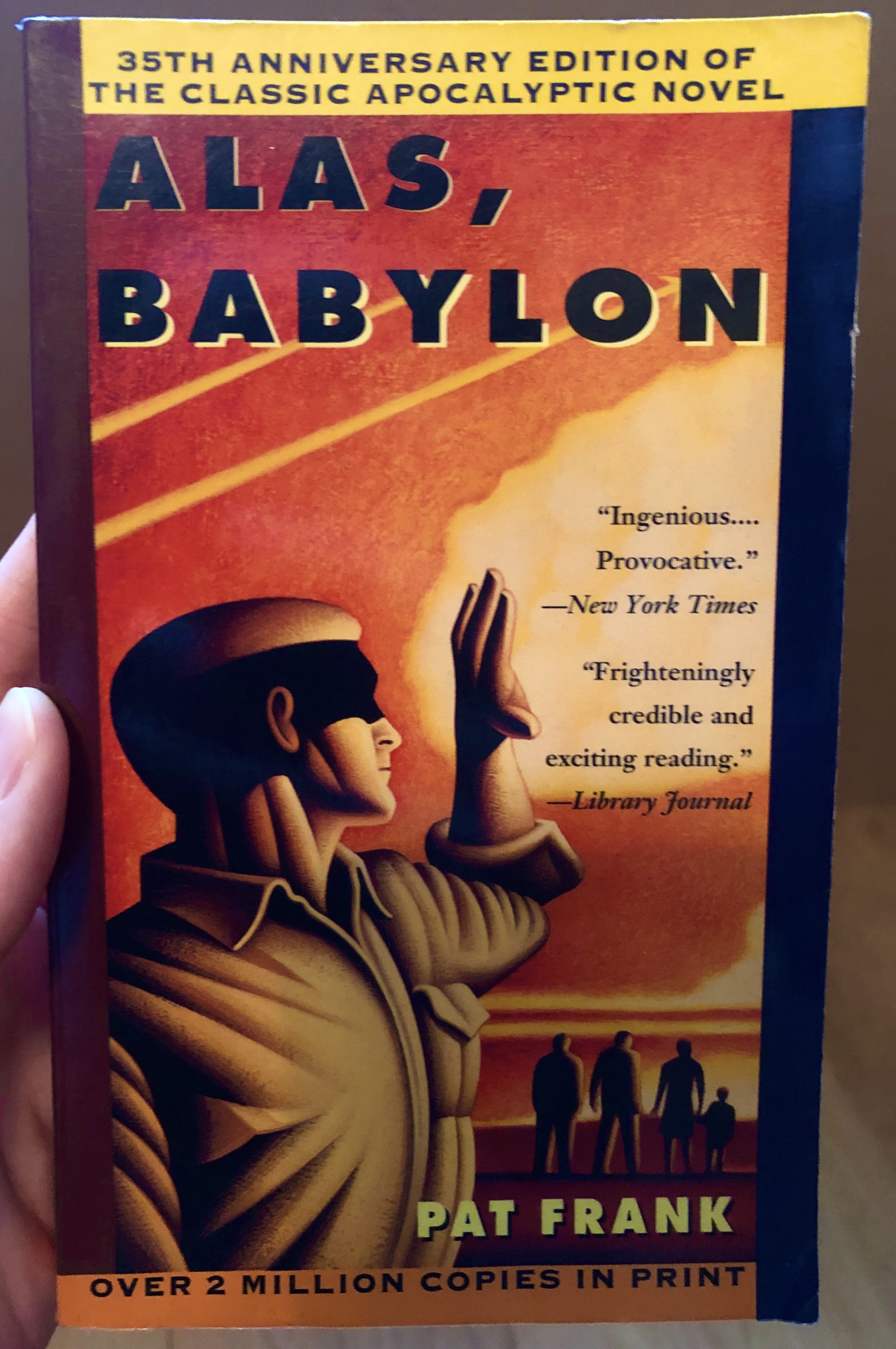
  • Classic with a place in the title: Alas, Babylon -P.  Frank
  • Classic with nature in the title: Cold Sassy Tree -O. Burns
  • Classic about a family: Pride & Prejudice -J. Austen
  • Abandoned classic: The Picture of Dorian Gray – O. Wilde
  • Classic adaptation: Little Women -L. Alcott

We’ll see how it goes! I need to finish the two books I’m currently reading, and then I’ll tackle one of these. Maybe I should start with Kristin Lavransdatter since it’s a hefty tome (Goodreads tells me it’s 1144 pages).

General reading goal: 45 books in 2020. We’ll see how it goes!