Many Waters Review

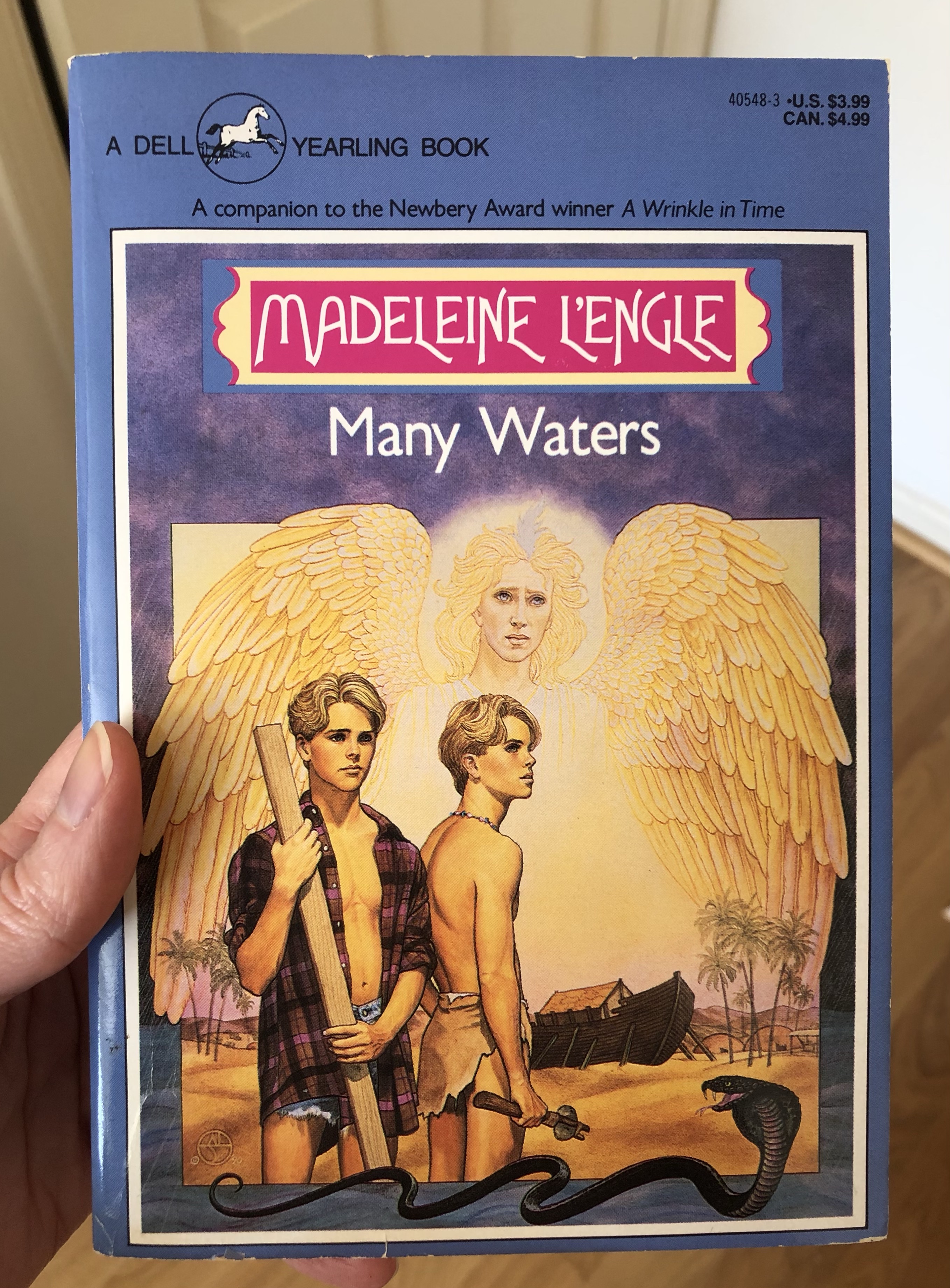
Many Waters, by Madeleine L’Engle, was published in 1986 and is the fourth book in a series about the exceedingly strange adventures of the Murry children.

Somehow, though I read and loved the first three books in the series growing up, I missed reading book four, so I thought it was time to rectify that mistake.

This story follows twins Sandy and Dennys (which I think is just an alternate spelling of “Dennis”? I have never been 100% sure). They are the most “normal” presenting of the brilliant Murry children, and did not go on the adventures that their siblings Meg and Charles Wallace went on in the first three books.

Sandy and Dennys, arriving home one winter afternoon, don’t see the sign on the door of their parents’ lab/ garage that says “experiment in progress” and are flung back in time—all the way back to the time of Biblical Noah.

It’s an interesting look at what things might have been like in a strange time in a strange story. I have lots of questions about unicorns and mammoths now, but also, it’s weird to include unicorns and mammoths in a pre-flood culture—did they just go extinct? I have mixed feelings about the success of the story which, while interesting, seemed very far removed from any story set on Earth.

I kind of wish Sandy & Dennys had traveled to a different planet instead of being flung back in Earth history, because thinking that this was supposed to just be primitive Earth brought up so many more questions than otherwise.

In general, I think the first three stories in this set are stronger, though that could also be that I experienced those stories as a child. There’s no nostalgia for this story for me, and that might be a contributing factor.

★ ★ ★

My Cousin Rachel

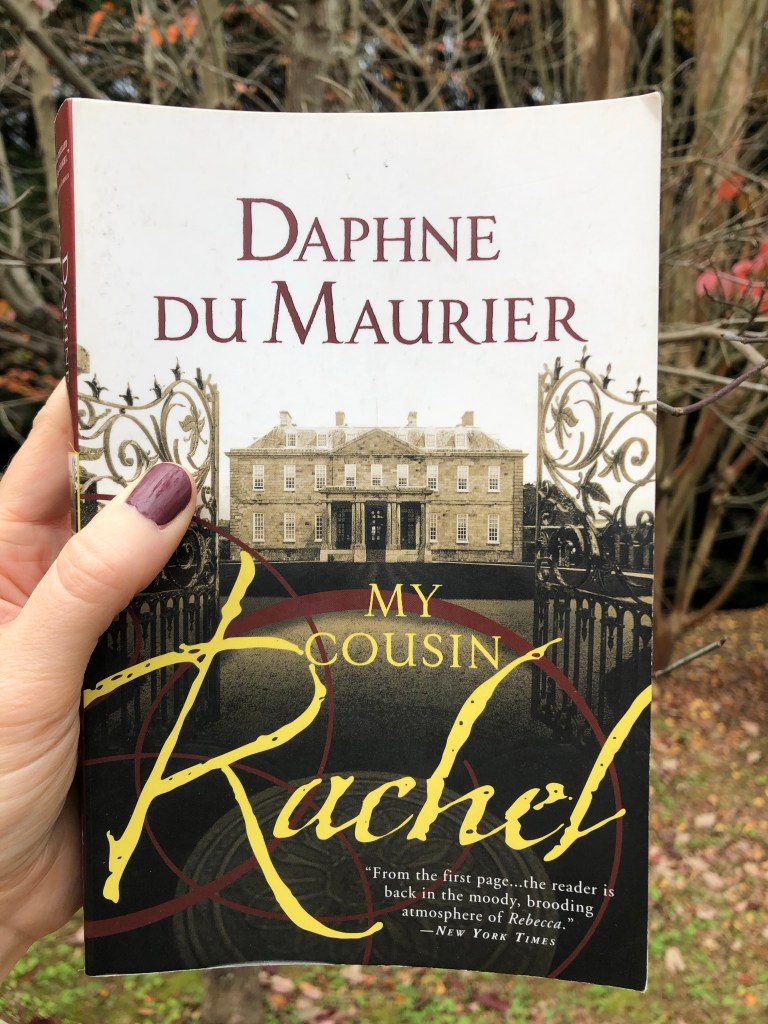
Written by Daphne du Maurier, published 1951.

It’s not really fall without one slightly creepy book, is it? Du Maurier is probably best known for her book Rebecca, but My Cousin Rachel is another story with a young, somewhat naive narrator who is overshadowed by a mysterious woman.

Philip Ashley has grown up under the tutelage of his cousin Ambrose, a bachelor, on the Ashley estate in Cornwall, England. When Ambrose goes abroad for his health, Philip runs things at home and is surprised to read in letters that Ambrose has married a woman named Rachel. Ambrose soon becomes ill and then paranoid that Rachel and her Italian financial advisor, Rainaldi, are poisoning him. Eventually, Abrose dies in Italy.

Philip is convinced that Rachel is a murderess, but his godfather thinks it a symptom of a hereditary brain tumor.

Rachel comes to visit…and Philip is smitten. Being 24 and never even having a crush on a girl, he doesn’t realize his unhealthy infatuation for a long time, though it’s obvious to his friends.

Since the book is written exclusively from Philip’s perspective, we are often left a little in doubt of others’ motivations and are left with his interpretations of events. Is Rachel a gold-digging widow come to get money out of a young, impressionable heir? Is she a murderer? Is she an impulsive pretty woman with uncertain (read: not English Protestant) morals? How does she really feel about…anything?

Part of what’s interesting about this story is that with the limited perspective, a lot is open to interpretation. I would love to read this with a group and hear multiple perspectives and theories about what really happened. Philip has his own views of what happened, but do they reflect reality?

★ ★ ★ ★

North & South Review

Author: Elizabeth Gaskell

Publication date: 1855

19th century British writing is one of my sweet spots, so obviously I enjoyed North and South.

I think I discovered Gaskell from the Modern Mrs. Darcy blog as “what to read when you’ve read all of Jane Austen.” While I think this is accurate, I also think Gaskell was interesting in using her novel to explore the plight of the workers in manufacturing towns who could barely feed their families. Though this story was not completely about this, it was certainly a prominent theme and discussed at length by various characters.

Margaret Hale, the protagonist, goes back to live with her parents in a Southern English parish after living in London with her aunt and cousin. Margaret’s father soon leaves the church as a dissenter, and moves his family to the Northern town of Milton.

There Margaret sees the contrast between her previous rural, out-of-doors life and her new life in a smoky, bustling, industrious town. She befriends a working-class family and clashes with her father’s pupil the manufacturer Mr. Thornton. Obviously repressed British emotion ensues!

There’s a lot of talk of putting on a brave face and bearing up under difficulty, and Margaret does experience tragedy. It cam be a bit melodramatic at times, but this is still a lovely story that I enjoyed.

I’ve heard North & South compared to Pride & Prejudice as “Lizzy and Darcy but in a manufacturing town!” and it is an opposites-attract story. While Pride & Prejudice is lighter with more witty/ ridiculous characters, North & South has more earnest discussion of strikes and working conditions and the struggle and occupation of life, but in both stories the main characters come to realize their first impressions might have been hastily formed and someone who they first dismissed might actually be someone who could help them grow and become happy.

★ ★ ★ ★ ★

Barchester Towers review

Barchester Towers, by Anthony Trollope

Published in 1857, this is book 2 of Trollope’s Barchester series, but I thought it stood alone pretty well. I’m sure I would have had a deeper appreciation for the characters if I’d read The Warden first, but here we are.

This is a book about local church politics in 19th century England. We open on the deathbed of the bishop of Barchester, attended by his son and his son’s father-in-law (both also clergymen).

The bishop’s son, Dr. Grantly, is not made bishop upon his father’s demise (he doesn’t know the right people in government at the time), so we meet Dr. Proudie, the new bishop, who arrives with his ambitious wife and extra-ambitious personal Chaplain Mr. Slope.

The new bishop, his wife, and Mr. Slope immediately stir the clerical pot at Barchester when there are clerical appointments with comfortable incomes to fill and numerous clergy about, all circling these positions.

There are political machinations, betrayals, misunderstandings, proposals, and comedy all at play in this book.

Trollope has a habit of spending a chapter introducing each new character or family, which is helpful on the one hand and delays the story on the other.

While there are characters to root for–and some who grew on me by the end–there are many characters who are either slimy (Mr. Slope is apparently literally so as several characters go out of their way to avoid touching his moist hand), over-ambitious (Mrs. Proudie rules the roost as behind-the-scenes bishopess), completely mercenary (the Stanhope family), or who are just barely on this side of likable (Mr. Grantly, who recruits actively against Mr. Slope and who misunderstands his sister-in-law Eleanor). Even the attractive widow, Eleanor Bold, whom the narrator obviously favors, is not completely without her faults, which I appreciated.

The church politics may be a bit confusing at times and the pacing a bit uneven, but the characters in this book are great fun and I enjoyed this foray into the fictional county of Barchester. Does one county require quite so many clergymen though?

Read for my 50 Classics project and the Classics Club Spin #24

Alas, Babylon review

Alas, Babylon, by Pat Frank

I first read this book in high school, and remembered enjoying it, though the details were fuzzy.

It was published in 1959 during the Cold War, and is set in a small central Florida town. Life is proceeding as usual when a young American pilot follows a Russian aircraft out of American airspace and shoots it down. Russia responds by firing nuclear weapons at American cities and presumably America responds in kind. Our characters don’t know what happened for a long time as nearby cities are obliterated, electricity and infrastructure knocked out, and travel impossible.

This becomes a tale of survival for the Bragg, Henry, and McGovern families and their neighbors. They have to figure out how to feed themselves, get water, cope without news of the wider wold, and fend off looting highwaymen.

It was interesting to read about this kind of disaster while living through another different kind, and I’m so glad not to be foraging for food right now or trying to make trades with my neighbors so we can all survive.

While I enjoyed this book, it’s definitely a product of its time; the Henrys are a black family, and as such, are looked down on by most of the white society (until everything falls apart and they’re actually the most prepared). It’s an uncomfortable reminder that “all men are created equal” in our founding documents is something we still need to strive toward. Frank’s main character, Randy, also thinks at one point, “The more [I] learned about women the more there was to learn except that [I] had learned this: they needed a man around.” I rolled my eyes pretty hard at that one.

Also, we really don’t want a nuclear holocaust. This book shows how hard it would be to survive even if you were in a pocket spared by radiation. Living only a couple hours south of Washington DC, I’m pretty sure I wouldn’t make it in such a scenario. So let’s all keep our fingers off those launch buttons please and thank you.

★ ★ ★