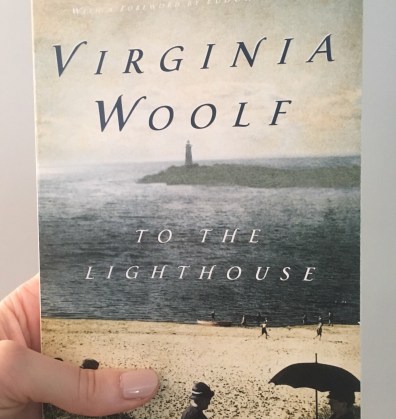
To the Lighthouse

 I’ll open with a confession: I don’t really care for stream-of-consciousness style of writing, and this book was a lot of that.
This book is about a particular group of people (centrally the Ramsay family) at a particular point in time, and then the family again, a few years later on another day.  Woolf primarily goes from person to person as the day progresses, detailing their inner monologue.

In fairness, there are moments when I think Woolf really captures how one’s thoughts can jump so quickly between being happy with another person and then feeling so distant the next. We are all paradoxes, and there are some lovely passages in this book that feel really true.

However, I didn’t really enjoy reading this book. I enjoy stories and books with a bit more plot. I’m fine reading about the thoughts of characters as a part of a story, but I don’t want a book almost wholly composed of those thoughts.

It was exhausting to me to keep jumping from person to person, hearing their sometimes self-indulgent thoughts, and I wanted to know more about what happened in the time between the two days. The first day is before World War II, and the second day after. In between these times, several characters die in asides in the brief middle passage, with not much notice taken, which is interesting in one sense, and maddening in another.

I’d love to hear from someone who enjoys Woolf, and this book in particular, to see what I’m missing, or what appealed to them.

★ ★

The Broken Earth Trilogy

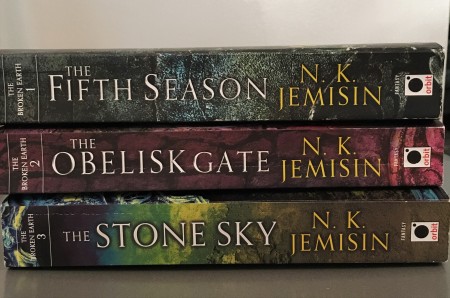
Broken Earth Trilogy PicI recently finished reading N. K. Jemisin‘s Broken Earth Trilogy: The Fifth Season, The Obelisk Gate, and The Stone Sky.

The first book starts with a cataclysmic event from the perspective of an unusually gifted woman who then starts on a quest to find her missing daughter. The book shifts between three female perspectives and doesn’t really stop to let you catch up–there isn’t time. I was intrigued but also confused for the first 50 pages or so. I discovered later that there is a glossary of terms in the back of the book, which might help the first-time reader (I’m impatient though, and hate flipping to the back, so I took the approach that eventually I’d figure out what all these new words meant. I did, so it worked out).

The second and third books expand this fractured, pain-filled world further, and Jemisin’s imagination is on display here. Her characters are messy, interesting, and just trying to survive. In a brutal dying world, all choices are hard.

The books explore the relationships between oppressed and oppressor, and what happens when the rules shift during times of disaster.

These books all won awards (the first two won the Hugo and the third won the Nebula), and I think well-deservedly. They are well-written, fast-moving, heartbreaking, and I deliberately read them slowly so I could remember them better (I hope) than if I just inhaled them.

A friend lent me these books after I read Dune earlier this year, and there are certainly parallels: inhospitable environments, power struggles, and quests. Where Dune is more science fiction though, I’d call The Fifth Season fantasy (some people have magical abilities, and we don’t need an explanation of why). But they share some similar tones. The Fifth Season also has a female protagonist, while Dune is heavily male-centric.

Dune has more political machinations, and in the Fifth Season trilogy, I think the characters are more nuanced. Both are great feats of imagination, which is what I love about science fiction and fantasy stories. While we can escape into theses stories for a while, their ideas linger into the real world and make us question the way we approach our real problems.

EDIT/ UPDATE: It was just announced that The Stone Sky has won the 2018 Hugo award, so now all three books in the Broken Earth trilogy have won this award! Awesome.

Othello

sammie-vasquez-490032-unsplash I’ve started my “50 Classic books in 5 years” challenge with Shakespeare’s Othello (chosen by the Classics Club Spin for August). Since it’s nice and short, I’ve finished it already, so it’s good to start with something quick to get started.

I’m familiar with the plot of Othello, but I’m not sure if I’ve ever seen it performed, so I’ll have to add it to my list.

The downside of reading a Shakespeare play is wading through the dense and often unfamiliar language and risking missing some of what’s going on. The upside is recognizing some Shakespeare-coined phrases (“O! beware, my lord, of jealousy; It is the green-ey’d monster which doth mock the meat it feeds on.”).

I enjoyed reading about the adventures and misadventures of the characters and rolled my eyes at everyone calling Iago “honest” and “trustworthy.” I forgot how he played everyone the whole time. That guy really held a grudge!

Also, the story wrapped up quickly there at the end with lots of stabbing and a little strangling. Those people really just took Iago’s word for it that they needed to kill with no other proof and got to the killing.

Two great comedy takes (fair warning: there’s some not-safe-for-work language here): Key & Peele on Othello and If Desdemona Had a Sassy Gay Friend

A brief review can’t do this great play justice, but I definitely recommend re-reading Othello, and I hope I can get to a production sometime soon!

“I kissed thee ere I killed thee, no way but this, Killing myself, to die upon a kiss.”

★ ★ ★ ★

Photo by Sammie Vasquez on Unsplash

Books, books, books!

boy-reading-surpriseOnce again, I’m embarking on a book reading challenge that I may (or may not–but let’s stay optimistic here!) complete. I’ve read some interesting books this year, but I also want to sprinkle in some more classics, and I want a moderate degree of accountability to read some books on my “I really should get around to reading this–it’s a classic!” list.

So I’ve joined the Classics Club and their 50 books in 5 years challenge. Here’s my big list.

I’m not sure exactly where to start, so I’m going to create this list of 20 of the books, wait for the Classics Club August Book Spin, where they will pick a number, and that’s the book I’ll start with. To give myself a good chance of not quitting immediately, I’m only picking books with less than 450 pages for this first month. I looked up the books on Goodreads and grabbed page numbers from there. My actual page count may vary depending on what edition I read, but I thought at least that would give me a general idea.

If you’re curious, the longest tome on my list is War & Peace, with 1275 pages. Yeah, I’m not going to start there.

Here are my options (I have more books under 450 pages, but I grabbed 20 at random):

  1. Forster, E.M.: Room With a View (119 p)
  2. Woolf, Virginia: To the Lighthouse (209 p)
  3. Gaskell, Elizabeth: Cranford (257 p)
  4. Wharton, Edith: The Age of Innocence (332 p)
  5. Waugh, Evelyn: Brideshead Revisited (351 p)
  6. Burns, Olive: Cold Sassy Tree (405 p)
  7. Sayers, Dorothy: Have His Carcase (440 p)
  8. Hemingway, Ernest: A Moveable Feast (192 p)
  9. Shakespeare, William: Othello (314 p)
  10. Christie, Agatha: A Murder is Announced (288 p)
  11. L’Engle, Madeleine: Many Waters (352 p)
  12. Wilde, Oscar: The Picture of Dorian Gray (367 p)
  13. Cather, Willa: My Antonia (232 p)
  14. Marquez, Gabriel Garcia: Love in the Time of Cholera (348 p)
  15. Du Maurier, Daphne: The House on the Strand (352 p)
  16. le Carre, John: Tinker, Tailor, Soldier, Spy (381 p)
  17. Austen, Jane: Persuasion (249 p)
  18. Camus, Albert: The Stranger (123 p)
  19. Gaskell, Elizabeth: Mary Barton (437 p)
  20. Alcott, Louisa May: Little Women/ Good Wives (449 p)

I’ll be back to let you know what I’m reading first!

UPDATE: The Classics Club spin chose #9, so I’m starting with Othello. An interesting place to start! I’ll let you know how it goes.

https://youtu.be/MIqFgimdJ6o

Photo by Ben White on Unsplash

Dracula

I thought the winter would be a great time to dive into the adventures of the original vampire. The story was somewhat familiar, not least because of the popularity of horror-story creatures in movies and tv shows these days. I think these stories have just about reached saturation, but I thought I’d visit the original tale before enthusiasm completely dies out (see what I did there?).

Since it was published in 1897 by Bram Stoker, the style of writing occasionally meandered a bit more than I’d like, but for the most part the story moves along at a good clip.

The book also consists mostly of diary entries and letters of the protagonists, with very little other narration — an interesting frame to the story. The reader only sees Dracula through the narrative eyes of other characters, which I think heightens the sense of mystery around him.

The Story

The story starts with Jonathan Harker, a solicitor’s clerk, who goes to visit his client, Count Dracula, in Transylvania to inform him of the purchase of a home for the Count in England. After arriving, Harker is trapped in the Count’s Castle and eventually left there for the three vampire women who live with the Count to feast on once the Count has left for England and fresh blood. Fortunately for Harker, he’s clever and escapes.

Meanwhile, his fiancee, Mina, is in England with her best friend Lucy. Dracula is on board a ship that happens to land at the seaside town where Mina and Lucy are staying, which is a huge coincidence. Later Mina notices that Lucy is growing pale and is sleepwalking a lot.

If Mina had watched more tv, she’d have recognized the signs, but alas….

Anyway, adventures ensue, with vampire-hunter Van Helsing arriving midway through the book to help track down and destroy the evil Un-Dead before he can claim more victims. He brings a lot of garlic and a lot of vampire knowledge, which is good for the protagonists and bad for Dracula.

Other Thoughts

Since this story was written by a male author in the 19th century, there were a few times I rolled my eyes at the depiction of Mina and Lucy. When the vampire hunting is in full force, the men decide that although Mina has been super helpful and transcribed all their notes and organized them (to be fair, Jonathan helps her some), for her protection they stop telling her what’s going on and keep her in the dark. Because…she’s a woman and should be spared the worry. They respect her though, because she has a brain that’s shockingly almost as smart as a man’s. Cool cool.

So this awesome plan of protection backfires when the next morning she turns up pale and somewhat blood-drained…. Good job, guys. Never leave someone out of your plans if you’re in a horror story! So other than a few eye-rolling remarks about men vs. women, I enjoyed the tale of suspense.

Also of interest were the abilities Dracula possessed and his weaknesses when compared to other vampires in pop culture. The one thing I didn’t quite understand was that Dracula couldn’t cross flowing water on his own, unless it was at low or high tide? I’m not really sure about the symbolism of flowing water as it relates to vampires, so if anyone knows, pass that along.

All in all, a pretty good horror tale.

Also, at no point does Dracula say, “I vant to suck your blood!” That’s a relief.

Rating

★ ★ ★ ★