Books Read: North and South

This alas, is only the second in my TBR books challenge. But I’ve now read two of the longer books on my list, so that’s good, I guess? I just got more books from the library today, so I’m making more progress!

North & South, by Elizabeth Gaskell

Title & Author:

North & South, by Elizabeth Gaskell (1854-1855).

Summary & Thoughts:

The story primarily follows Margaret Hale, daughter of an ex-vicar who has left his profession, as she adjusts to life in a strange place in Milton, a cotton-mill town.

The family (a father, mother, and grown daughter) has difficulty learning the culture of the place in which they find themselves. As the title suggests (once you realize it’s a 19th century British novel, not an American Civil War novel), a large part of the book is the clash of the Southern sensibilities and slower pace the Hales bring with them when they relocate to Milton in the North; a bustling factory town with a harsher feel yet productive people.

North & South also includes a brooding, Darcy-esque mill owner, Mr. Thornton, who becomes a pupil of Mr. Hale’s, and an admirer of Margaret’s. The narration usually follows Margaret, but occasionally we get Mr. Thornton’s inner thoughts as well, usually when those thoughts are about Margaret.

While the romance is fairly central, there is also a great deal of discussion about factory economics, and the responsibilities of mill owners, who have a great deal of authority. It was more interesting than I anticipated reading the various opinions on the business side of the book. As well as talking to Mr. Thornton about his views on the responsibilities of mill owners, Margaret befriends Nicholas Higgins, a factory worker, and hears his side of the question as a member of the workers’ Union. There are many discussions of how to protect both the interests of the workers and how the owners/managers ought to act as authority figures who ought not abuse their position of power.

The book has a little of a Pride & Prejudice feel, with the brooding rich man and the outspoken, strong-willed heroine without a fortune.

Apparently Gaskell discusses industrialism and economics and politics more in some of her other works, but I thought this book struck a good balance. I’m not sure that I would have read a book on industrial Britain’s economics alone.

Gaskell doesn’t quite have Austen’s style, but the writing was engaging, and some passages are really beautifully well-written. If you like Jane Austen and want something in a similar vein, give Elizabeth Gaskell a try.

There’s also a BBC adaptation which is fairly faithful to the book. Of course, there are a few exceptions, like the last scene taking place in a train station instead of a drawing room. Because, drama? But overall I thought they did a good job of capturing the feel of the book and the main events.

It’s also a change to see Richard Armitage (aka Thorin from The Hobbit) at normal human height (he’s actually rather tall) and Brendon Coyle (aka Mr. Bates from Downton Abbey and Lark Rise to Candleford) play the same part (magical disappearing limp not included).

Tl;dr:

I liked North & South, and if you like Jane Austen, give Elizabeth Gaskell a try. Fewer balls; more discussions of industrial economics.

Also the BBC miniseries is worth a watch. You’ll probably see actors you know because there are only 30 actors in the UK.

Rating:

★ ★ ★ ★
Books Read: Special Topics in Calamity Physics

For my “TBR Pile Challenge,” I’ve read one book so far. I know, only one — sad. However, in my defense, it was 528 pages. And I’m also 72% of the way through “The Brothers Karamazov”! So I feel ok about that.

Title & Author: Special Topics in Calamity Physics, by Marisha Pessl (2006)

Summary and Thoughts: Blue van Meer, a teenager, is the daughter of an itinerant professor.

She opens by telling the reader that she’s going to talk about the death of Hannah Schneider, and then goes back in time to talk about growing up, moving to a small town, settling into a new school, and the events leading up to and following Hannah’s mysterious and unexpected death.

This book is sort of a mystery-memoir style, while also being incredibly literary. It was given to me by a friend who thought I would appreciate all the references, and I did. Pessl also uses unexpected similes and metaphors, and while they don’t work all the time, and some of the references go over my head, enough of it is accessible to still get the point and move on.

The point isn’t to look up all the references — you can still understand the story without them — but the references to add to the story. Each chapter title, for example, is the title of a book (usually classic literature). If you know the book’s general theme, you will have a clue to what’s going on in the chapter. If you don’t, you’ll find out what happens in the chapter anyway, so don’t let the over-literary-ness deter you.

While the book and narrator may be too literary and clever for its/her own good, it was still a fun read. The narrative threads become more complicated as you get near the end, but that’s all part of the fun.

Also, even though I don’t think I know any teenagers as crazy-smart as Blue, it still made me glad to be an adult and not a teenager. I’m so glad to be finished with that part of my life — being an adult is, in many ways, preferable to being a teenager.

Rating: ★ ★ ★

Book Reviews/Recaps!

Book pages

Since I’m going for the 2015 TBR Pile Challenge this year, and also because I think it will help me remember books I’ve read in general (and I have friends who do similar things), I want to start posting about books I’ve read. I don’t know if I’ll put every book I read here, but I at least want to document my thoughts on them, and invite conversation about books.

Tell me why you disliked a book I liked, or why I should give a book I didn’t like a second chance.

Also, tell me if you prefer Austen or Bronte. I hear usually people fall into one of those categories. Personally, I love both. It’s weird, actually. I have read numerous blog posts/ articles by someone who loved Jane Austen and couldn’t get into Jane Eyre, or people who pledge undying devotion to Jane Eyre and think Pride and Prejudice is just meh. It seems many people prefer one or the other.

I understand that they have very different tones, but I love them both. I would happily pick up Pride & Prejudice or Jane Eyre any day and read them again. Just tell me you want to do a re-read of either and I will leap at the excuse.

…But I digress. Someday I’ll try to analyze why people fall so hard along these lines (and why I don’t want to pick sides). Without further ado, the real point of this post!

Here’s the tentative format (all subject to change at the whim of management):

  • Title & Author (and year of publication)
  • Brief Summary (hopefully spoiler-free or spoiler-light. I’ll warn you if I want to say something spoiler-y)
  • Other thoughts I had on the book
  • Goodreads/Netflix style, I’m also going to try incorporating a star rating for how much I liked the book (I might change my mind tomorrow and think a star rating is a terrible idea. I’m going with it for now).

Maybe I’ll do that with some movies too. Who knows.

Photo by Send me adrift. used under Flickr Creative Commons License.

“To Be Read” Pile Reading Challange

Last year I started the “Back to the Classics” reading challenge. It seemed like a great idea, but then I got bogged down in “The Brothers Karamazov,” and after that I read some but never really recovered from being over-ambitious in January and then not moving on from that quickly enough to keep going. So I didn’t post any updates. Fail.

Also, in the fall we bought a house, so that kind of ate up my free time. Guys, buying a house is like having a part-time job. My head was too full to do much serious reading.

This year, instead of trying that challenge, I’m going to try one called the “TBR Challenge,” which is basically an attempt to read those books you’ve bought or otherwise had on your list of books to read, but for whatever reason, haven’t gotten around to yet.

I’m picking one per month, so 12 books, but I realize some longer books might take a while. We’ll see how I do.

Here’s a link to the post in case you want to sign up or check out the rules.

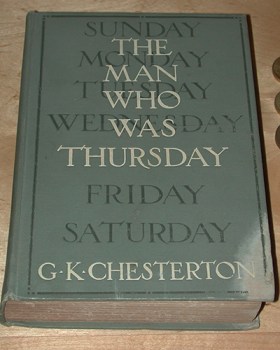
man-who-was-thursday

And here are my 12 books (not necessarily in the order I want to read them in):

  1. The Picture of Dorian Gray – Oscar Wilde (1891)
  2. The Man Who Was Thursday – G.K. Chesterton (1908)
  3. North & South – Elizabeth Gaskell (1855)
  4. Special Topics in Calamity Physics – Marisha Pessl (2006)
  5. Awakenings – Oliver Sacks (1973)
  6. Gilead -Marilynne Robinson (2004)
  7. The Secret Adversary -Agatha Christie (1922)
  8. Crooked House – Agatha Christie (1949)
  9. The Immortal Life of Henrietta Lacks – Rebecca Skloot (2010)
  10. The Ocean at the End of the Lane -Neil Gaiman (2013)
  11. A Wizard of Earthsea -Ursula K. Le Guin (1968)
  12. Ender’s Shadow – Orson Scott Card (1999)

And 2 alternates, in case I get in too deep and am not going to make it with one of the others (such a kind rule!):

  1. Nathan Coulter – Wendell Berry (1960)
  2. Bird by Bird – Anne Lamott (1995)

I’ll also try to remember to link back to this post with updates throughout the year. Here’s to hoping I’m steadier in my reading plan in 2015 (apologies in advance if I’m not).


Photo by C.J. Kershner used under Flickr Creative Commons license.

Back to the Classics Challenge – 2014

A couple years ago I tried to participate in a “Back to the Classics” challenge, and I sort of…fizzled out somewhere in the middle of the year. I might have gotten engaged (slightly distracting in the best way), which cut down on plans to plow through classic works of literature. I think that is a pretty good reason to set aside a challenge. In any case, I’m married now, and not planning anything big, so I’m going to try again.

If you’re interested in participating, go here to see the details from the host, “Books and Chocolate.” Here are a few of the guidelines:

I am defining a classic as a book that was published at least 50 years ago.  Therefore, any book published after 1964 is ineligible. 

Here are the rest of the guidelines:

  • All books must be read in 2014.  Books started prior to January 1, 2014 are not eligible.  Reviews must be linked by December 31, 2014.
  • E-books and audiobooks are eligible!  Books can count for other challenges you may be working on.  However, books may NOT crossover categories within this challenge.  You may NOT count the same book twice for different categories in this challenge.  
  • If you do not have a blog, you may link your review from Goodreads or other publicly accessible online format.
  • Please sign up for the challenge using the linky below BEFORE MARCH 1, 2014.  Please link to your sign-up announcement post (if possible/applicable).
  • You do not have to list your books prior to starting the challenge, but it is more fun that way :).  You can always change your list at any time.  You can read the books in any order (including mixing in the optional categories at any time).
  • You can decide to attempt the optional categories at any point (you can also bow out of the optional categories at any point as well).
  • Please identify the categories you’ve read in your wrap-up post so that I can easily add up your entries for the prize drawing!

And to clarify, you have to read different books for each category — you can repeat authors or genres, but no fair using the same book multiple times within this challenge! The only book that you can repeat is in the movie/TV adaptation review.

Ok, so here are my picks (which are subject to change, and probably will not be read in order):

Required:

  1. A 20th Century Classic – My Antonia – Willa Cather
    [I read this in school and was, I must admit, bored. Too much description! Not enough action! My mother tells me I should give it another chance.]
  2. A 19th Century Classic – The Picture of Dorian Gray – Oscar Wilde
  3. A Classic by a Woman Author – something by Jane Austen for a book club–we haven’t picked one yet, so I’ll update when I know what we’re reading
    ***we’re reading Emma!***
  4. A Classic in Translation – The Brothers Karamazov – Fyodor Dostoevsky (Pevear/Volokhonsky translation).
    [I have tried to read this twice, and got bogged down, last time during the life story of the monk whose name I forget — I’m going to start with this book in January because A) I think Russian novels ought to be read in the winter and B) I want to start while I’m still enthusiastic about this challenge.]
  5. A Wartime Classic – War of the Worlds – H.G. Wells
  6. A Classic by an Author Who Is New To You – Fahrenheit 451 – Ray Bradbury
    [I missed this one in school, somehow. Guess you can’t read everything.]
Optional Categories:
  1. An American Classic – Still thinking about this one. Suggestions welcome.
  2. A Classic Mystery, Suspense or Thriller – The Man Who Was Thursday – G.K. Chesterton
    [I got this for Christmas 2 years ago and it’s been sitting on my nightstand. It is time.]
  3. A Historical Fiction Classic –  A Tale of Two Cities – Charles Dickens??
    Suggestions welcome here too. I’m having a hard time thinking of a classic that’s historical fiction.
  4. A Classic That’s Been Adapted Into a Movie or TV Series –  North & South – Elizabeth Gaskell??
    Also subject to change.
  5. Extra Fun Category:  Write a Review of the Movie or TV Series adapted from Optional Category #4 –North & South, or whatever I end up choosing.
    [The 2004 version of North & South reminds me that Richard Armitage is actually pretty tall in real life, unlike his recent role.]

Anyone want to join me in the challenge?