50 Classics in 5 Years Recap and Next Challenge

Greetings, internet! The date of my last entry tells me I have neglected this space for two years. It feels like a garden I have not tended where the grass and clover has overtaken the flower beds, and the whole thing looks a little sad and shabby. So it’s time to clear out some of the weeds, till the soil, and begin again.

In the summer of 2018 I discovered The Classics Club community, which encourages members (membership is quite loose) to read more classics by imposing the structure–a challenge–of reading 50 classics in 5 years. I wanted to include more classics in my reading life, and thought this sounded like a great idea. In August of 2018, I set out to read many classics (to accomplish this in 5 years requires completing 0.833% of a book every month, so a pretty steady pace).

All was going well. And then it was 2020 and all was not going well.

I think it is worthwhile to set goals and read classics. Having a challenge and a list is helpful, especially when a book is finished and it is time to pick up another one. Having a list narrows the choices, which I appreciate.

In reflecting back over my previous challenge, I identified a few things that I might change:

First, I tried to “one up” myself and increase the difficulty by choosing too many long books, and by choosing several sets of multiple books and counting them as one. I modified my list over time and took out some of these books (for example, Kristin Lavransdatter is actually a trilogy. Just because I own an omnibus edition does not mean I have to count it as one!). I am not being graded, nor will I get extra credit for doing more. There’s no need to make this challenge more difficult than it is.

Second, I started this challenge in 2018 and had no idea what the next few years would bring. I did not have the same attention span in 2020 and the couple years after that or the mental space for more challenging reading during the pandemic years.

My first plan to mitigate this was to give myself an extension to 2024, but I was already far behind and 2023 has been difficult for my reading life.

Instead, it is time to close the book on the first 50 Classics Challenge (pun absolutely intended), and start afresh. I hope that the next five years will be a bit better for my reading life, though who knows what lies in store.

This time, I want to be a little kinder to myself and choose some shorter books alongside the classic doorstop novels. I will, of course, choose some unread books from my previous challenge, but include some new titles and not keep everything from my last effort. I will also count books in a series or trilogy as one book each, instead of counting three books as one, etc.

I’m going to go from October 2023 to October 2028, instead of choosing the calendar year, because there are enough things that follow the calendar year, and I want to start while I’m excited for a new project and have a little momentum to start me out on this next adventure.

My list for Round 2 of the challenge is here: https://austinfey.com/50-classics-2/

Of course, I will not be reading only classics. Newer books will make their way onto my list, and I’ll have to decide if I want to review books read in a month or review books as I read them. We shall see. Books read for this challenge will get their own review posts, as usual.

I hope that your reading life is going well and I look forward to rehabilitating my own.
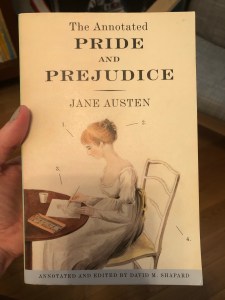
Image from Sergiu Valenas via Unsplash.

Pride and Prejudice Review

It is a truth universally acknowledged that a review of Jane Austen’s work is superfluous. Yet here I am anyway.

Pride & Prejudice book cover

This is one of my all-time favorite books. From my first reading as a teenager, taking extended “bathroom breaks” to read the small hardback with tiny print which I hid under the sink for such occasions (sorry, Mom!), I fell in love with Austen’s wit and style, her characters, and her well-paced story.

Published in 1813 and popular from the beginning, there is plenty of scholarship out there if you are interested in that. And it’s so well known that I don’t know that I can add much here but if for some reason you’d like a refresher, here’s a summary:

Mr. & Mrs. Bennet live in a village in Hertfordshire with their five daughters. They are not poor, but having no male heir and not being frugal, the daughters will have to rely on marrying well for future economic stability.

The novel opens with the arrival of two handsome and eligible bachelors to the neighborhood: Mr. Bingley (sweet and outgoing) and Mr. Darcy (introverted and has some…pride). The story follows the shenanigans of Mrs. Bennet’s attempts to marry off her daughters and how that works out for them all.

The Bennets’ second daughter, Elizabeth, is the protagonist of the novel, and she is active, energetic, outgoing, smart, and witty—and also opinionated and believes strongly in first impressions (so she can be…prejudiced). She is a fun character to follow, and she goes through a lot of growth by the novel’s end.

The characters are so well-drawn and the comic characters are both pretty great and ridiculous (but also can be dangerous and/or disappointing to their families). The book balances getting to know the many characters with a good bit of plot–we don’t sit around too long before the next event, and I appreciate that she keeps everything moving.

This book is rightly considered a classic, but I think it’s pretty approachable as well. While there are details like the entail of the Bennet property and other manners that can be confusing to the modern reader, the plot moves along and the characters are interesting that parts of it feel fairly modern. While the 19th century was a while ago and manners have changed, people are still people–that has not changed.

★ ★ ★ ★ ★

An Acceptable Time Review

An Acceptable Time, by Madeleine L’Engle (published 1989) is sometimes counted as the fifth book in the series about the Murry-O’Keefe family. Apparently there are more books about the O’Keefes and their adventures as a separate series, so I’m sure there are references to those that I missed. Or rather, I could tell there was elaboration on those adventures elsewhere that I just haven’t read, but this story was ok as a standalone (I think anyway—I don’t know otherwise as I haven’t read them!).

Polly O’Keefe, daughter of Meg, is staying with her Murry grandparents (who get names! Alex and Kate) after…something happened? I think a close family friend and mentor to Polly died, but it isn’t super clear to me.

Anyway, Polly stumbles back in time 3,000 years, but only for a moment, and meets two druids who tell her that the time gate is open. Then she spends many pages of the book mostly in her own time with her grandparents worried about what’s happening and forbidding her from going on adventures. While I’m sure it’s more realistic that the adults would be concerned that she might get trapped 3,000 years in the past, especially as they are just her temporary guardians, I see who most kid-goes-on-crazy-adventure books just have the kid go off without any input from the guardians: it’s boring to read all the objections, and it stops the story in its tracks.

Polly also has a friend, Zachary, who drags her back into time for the longer actual adventure part, and while I was grateful that he really kickstarted things, he gives a bad name to Zacharies everywhere.

He’s selfish, gaslights Polly, takes no responsibility for his actions, and in the end is treated far more kindly by the characters than he deserves (though that’s part of the point, but still…). He’s supposed to be charming, but I don’t see a lot of evidence of that—the “charm” seems to be confined to compliments to Polly, politeness to adults, and a bit of emotional manipulation. Clearly, I was not a fan.

The bits about people from the present and past crossing to each other’s time were interesting, and the characters from the past were good, but while it was interesting to imagine what culture might have been like 3,000 years ago, we don’t get enough time there to go much beyond stereotypes, and spent too much time in the lead-up. An ok book, but not one I think I’ll feel the need to revisit.

This was the last book I finished in 2020, though I ended the year 2/3 of the way through some Susanna Clarke short stories, so I ended on a better note than this.

★ ★ ★

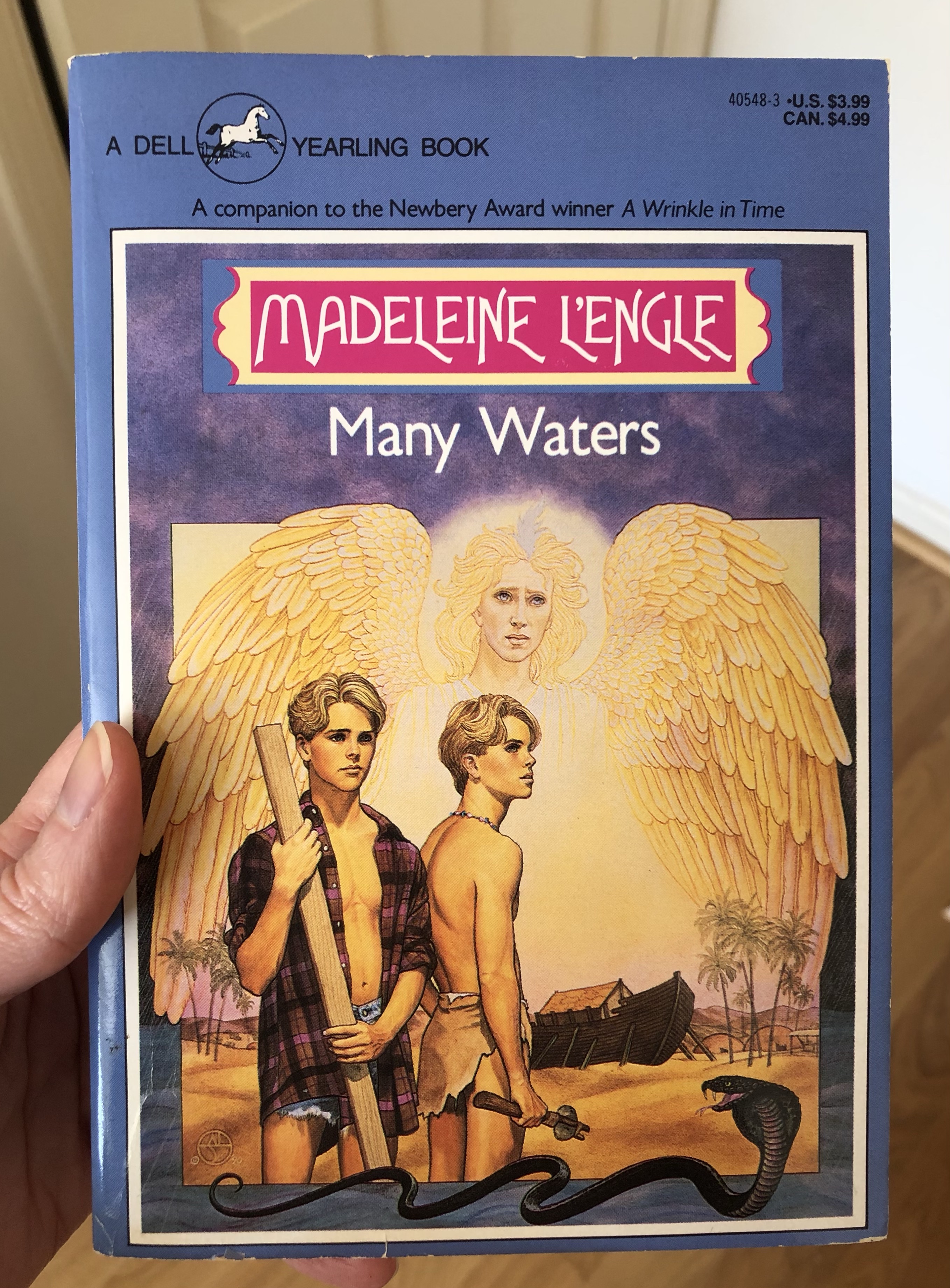
Many Waters Review

Many Waters, by Madeleine L’Engle, was published in 1986 and is the fourth book in a series about the exceedingly strange adventures of the Murry children.

Somehow, though I read and loved the first three books in the series growing up, I missed reading book four, so I thought it was time to rectify that mistake.

This story follows twins Sandy and Dennys (which I think is just an alternate spelling of “Dennis”? I have never been 100% sure). They are the most “normal” presenting of the brilliant Murry children, and did not go on the adventures that their siblings Meg and Charles Wallace went on in the first three books.

Sandy and Dennys, arriving home one winter afternoon, don’t see the sign on the door of their parents’ lab/ garage that says “experiment in progress” and are flung back in time—all the way back to the time of Biblical Noah.

It’s an interesting look at what things might have been like in a strange time in a strange story. I have lots of questions about unicorns and mammoths now, but also, it’s weird to include unicorns and mammoths in a pre-flood culture—did they just go extinct? I have mixed feelings about the success of the story which, while interesting, seemed very far removed from any story set on Earth.

I kind of wish Sandy & Dennys had traveled to a different planet instead of being flung back in Earth history, because thinking that this was supposed to just be primitive Earth brought up so many more questions than otherwise.

In general, I think the first three stories in this set are stronger, though that could also be that I experienced those stories as a child. There’s no nostalgia for this story for me, and that might be a contributing factor.

★ ★ ★

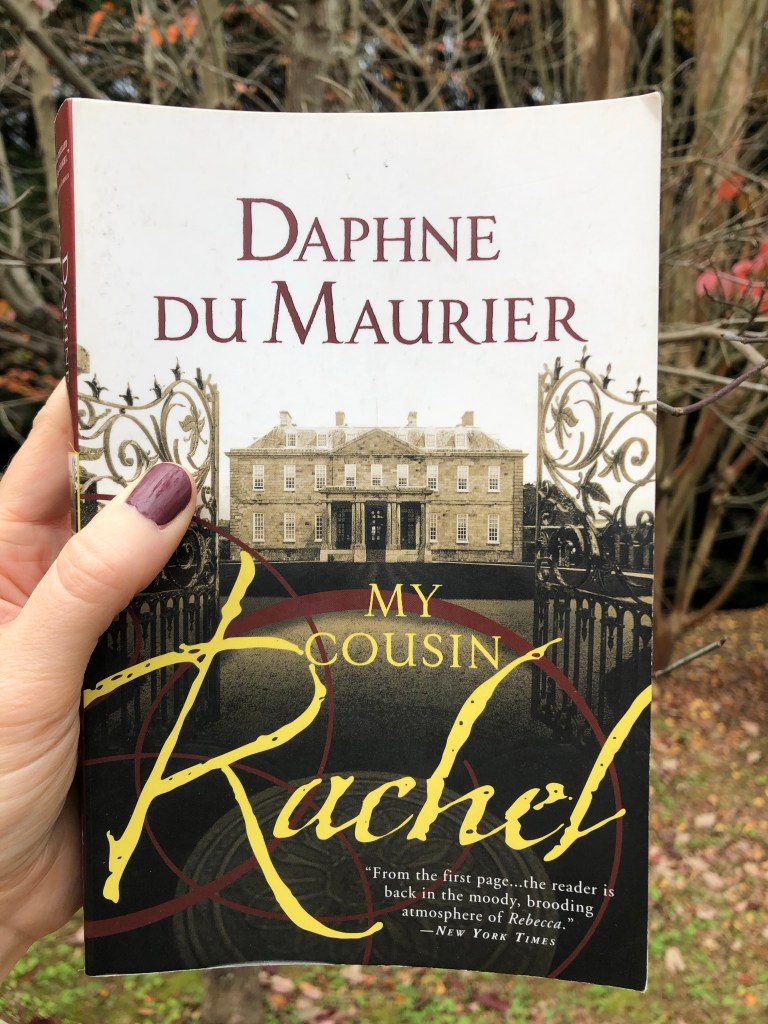
My Cousin Rachel

Written by Daphne du Maurier, published 1951.

It’s not really fall without one slightly creepy book, is it? Du Maurier is probably best known for her book Rebecca, but My Cousin Rachel is another story with a young, somewhat naive narrator who is overshadowed by a mysterious woman.

Philip Ashley has grown up under the tutelage of his cousin Ambrose, a bachelor, on the Ashley estate in Cornwall, England. When Ambrose goes abroad for his health, Philip runs things at home and is surprised to read in letters that Ambrose has married a woman named Rachel. Ambrose soon becomes ill and then paranoid that Rachel and her Italian financial advisor, Rainaldi, are poisoning him. Eventually, Abrose dies in Italy.

Philip is convinced that Rachel is a murderess, but his godfather thinks it a symptom of a hereditary brain tumor.

Rachel comes to visit…and Philip is smitten. Being 24 and never even having a crush on a girl, he doesn’t realize his unhealthy infatuation for a long time, though it’s obvious to his friends.

Since the book is written exclusively from Philip’s perspective, we are often left a little in doubt of others’ motivations and are left with his interpretations of events. Is Rachel a gold-digging widow come to get money out of a young, impressionable heir? Is she a murderer? Is she an impulsive pretty woman with uncertain (read: not English Protestant) morals? How does she really feel about…anything?

Part of what’s interesting about this story is that with the limited perspective, a lot is open to interpretation. I would love to read this with a group and hear multiple perspectives and theories about what really happened. Philip has his own views of what happened, but do they reflect reality?

★ ★ ★ ★