2025 Reading Year in Review (and Best Books)

Quitting my full-time job and studying for (and passing!) the CFP® exam meant I had more time last year to read books. Finishing my two-year study journey meant I finally had more capacity to read non-fiction (previously, my non-fiction brain slot was taken up with reading about tax, estate, retirement, insurance, investment, and general financial planning).

I read some non-fiction bangers this year, many of them on themes of politics, wealth, society, technology, and how these impact our lives. 

I also read a lot of mysteries last year to wind down while studying in the first half of the year, and read a mixture of other fiction over the year. 

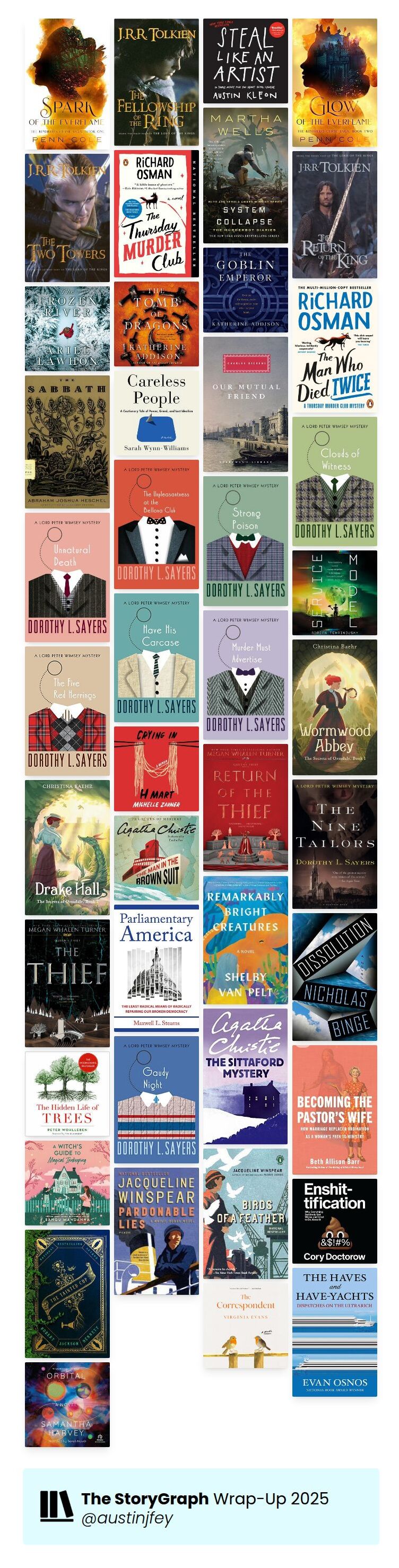
I finished 45 books last year, and while I fell off a bit on the blog with my month-in-review posts in the fall (which was busier than anticipated and also I got sick a couple times; I have drafts and will go back and publish these later), I feel pretty satisfied with my reading life. Of course, I would like to continue to push back against the machines and spend a little more time reading, so that’s a 2026 reading resolution, but I’m excited to keep reading this year! 

Choosing superlative “best” books of the year is a little fraught, but it’s helpful for me to look over what I read last year and see what stuck with me. Keeping track of my reading helps me remember what I have actually read, and helps the themes, characters, prose, and ideas stick with me more than just reading and immediately moving on from a reading experience. I don’t want to just consume books mindlessly; I want books to be a part of me in a real way, and I want to be in conversation with them. 

So here are my Top 10 from 2025:

  1. Enshittification, by Cory Doctorow 
  2. The Sabbath, by Abraham Joshua Heschel
  3. The Correspondent, by Virginia Evans 
  4. Careless People, by Sarah Wynn Williams
  5. The Thursday Murder Club, by Richard Osman
  6. Crying in H Mart, by Michelle Zauner 
  7. Dissolution, by Nicholas Binge
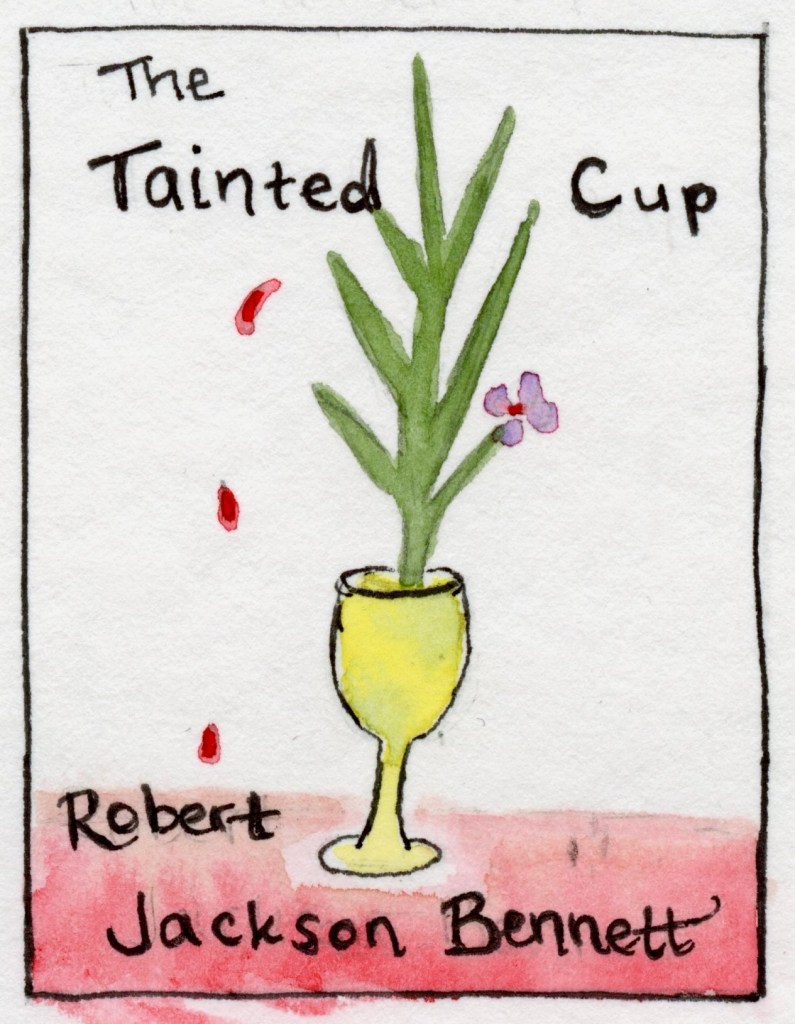
  8. The Tainted Cup, by Robert Jackson Bennett 
  9. Parliamentary America, by Maxwell Stearns 
  10. The Haves and Have Yachts, by Evan Osnos 

Honorable Mentions: The Lord of the Rings, by J.R.R. Tolkien; The Goblin Emperor, by Katherine Addison; The Thief, by Megan Whalen Turner; and Gaudy Night, by Dorothy Sayers. These are honorable mentions because they are all re-reads of books that I love, and I really enjoyed them once again, I just wanted to give a chance to some new-to-me books. 

What were your favorite books of 2025? What are you looking forward to in 2026? Any book resolutions? 

Books Read in September 2025, Part 1

Sorry for the delay getting this out. My scanner was not cooperating, and then I got busy, time passed, and it’s November already! But here are the first two books I read in September, which was an interesting reading month.

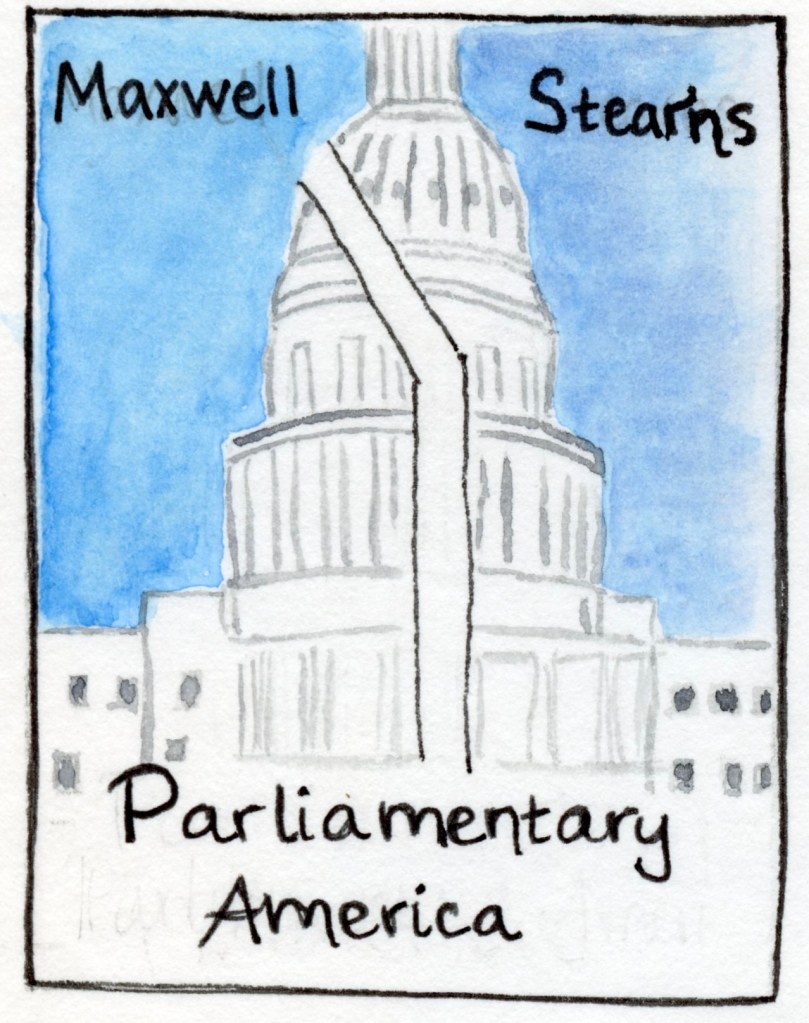
Parliamentary America, by Maxwell Stearns 

Published 2024

As a constitutional law professor, Stearns thinks that we are living through a third constitutional crisis (the first when the constitution was written, the second after the Civil War), a crisis that calls for action to repair our democracy and update our founding document for the challenges we face now. 

After laying out the problems of our two party system, especially legislative gridlock and a presidential office which has consolidated power, he takes us on a world tour to examine other forms of democratic governance. Stearns notes that many (most?) of their governments are organized as parliaments with a prime minister and/or president, not like our two houses of congress with a president (even when we have exported democracy, other countries are choosing parliaments instead of our system, which is telling).

Then Stearns proposes three constitutional amendments which would transform our system into a parliamentary system, which he believes would serve us better as a form of government, while still keeping most of the rest of our founding document in place. 

  1. Expand the House of Representatives (to about double its current size), which would mean that each representative would have fewer constituents than they currently have. 
  2. The majority party or parties would select the President (similar to the way that the majority party in, for example, the UK, selects their Prime Minister). 
  3. Give the House the power for a “vote of no confidence” to remove a President who fails to perform their duties (the bar is “maladministration,” which might allow for removal; our current impeachment method clearly is not working; the bar is set too high). 

Is amending our Constitution to transform into a more Parliamentary form of government radical? Yes, but also, as Stearns takes us through the world tour of democracies, he notes that pretty much all other democratic nations have some sort of Parliament.

I would love to see some dramatic reform like this, though how feasible it is is anyone’s guess. 

Our current system, however, is failing us. Stearns says (and I agree with him) that our current system has locked us into having only two parties, and those parties tend to pull to the extremes. We’re also in an era of extreme Presidential power. Power has been consolidated to the Executive branch at the expense of the other branches of government (and, I think, at the expense of the American people). 

Stearns says the political unhappiness of many Americans is feeling unrepresented in Congress, and as we are seeing in Trump’s second term, Congressional Republicans have ceded much (most?) of their independence to Trump anyway. Stearns posits that many Americans have more moderate political views, and that a multi-party Parliamentary system would allow more viewpoints to be represented, and would also allow coalition-building and incentivize moderation and compromise to get things done in government. 

I agree that his system sounds much more functional, but what I don’t know is if we have the political will to push dramatic changes through. Our government is currently being dismantled as quickly as the Trump administration is able to do so, which may give us an opportunity to rebuild something different (assuming we make it to the other side of this administration with our democracy intact). However, I think it will take some real political leadership and a strong push to make something like this happen. I am very interested in the idea of Constitutional reform, and I would love to have more viable parties to represent political interests (two parties are clearly insufficient for the task with a population of ~340 million). 

I have so many more thoughts on this and our current political situation, but those probably belong in a separate essay. For the purposes of this review, I think the ideas are interesting, I like that someone is out there with some bold suggestions for how we move forward out of our current malaise and the death spiral we currently seem to be locked in, and I hope that this sparks conversations and actual action to move us forward as a functioning 21st century country. One of my biggest complaints is that we have real issues to address and clearly a government that is not interested in addressing most of them. Our current Congress seems mostly uninterested in governing, and even if you think that government should mostly leave people alone, I think that most of us could find some agreement on a few issues where government is what we need to address some collective issues. Our current leaders mostly do not seem interested in tackling issues like adults, and I really want some adult people to work together to help us move forward. I’d love to talk about this book or other ideas! If you have read it, I’d love to hear your thoughts! 

The Sittaford Mystery, by Agatha Christie 

Published 1931 

Apparently this was originally published with the title “The Murder at Hazlemoor,” and I am really not sure why it was changed. Either title sounds equally interesting to me personally, but I’m also not a 1930’s publishing house. 

This is another Christie novel without including one of her best-known detectives. It is a standalone and I don’t believe any of the characters show up in other books. 

Mrs. Willet and her daughter Violet are renting a large country house in the winter (which everyone finds odd), and one evening they host a séance in which a “spirit” tells them that their landlord, Captain Trevelyan is dead. 

One of the Captain’s old friends, Major Burnaby, is alarmed and says he will go on foot (the roads being impassible due to snow) to check on his friend. He discovers (of course) that the Captain has been murdered! 

A police Inspector Narracot investigates the crime, and a young and extremely capable young lady, Emily Trefusis, also investigates on behalf of her fiancé, a nephew of the murdered man (an heir and a suspect). 

While I did not particularly enjoy the last standalone Christie I read (The Man in the Brown Suit), this is a more straightforward mystery which I did enjoy. There are the usual red herrings, people behaving suspiciously, people suspecting and trying to shield one another from suspicion (and therefore being stupid), and a clever murderer who was not quite as clever as our detectives. 

This makes the book sound formulaic, and in some ways it is, but I enjoyed it as a classic Christie novel that is fun and a worthwhile read.

Books Read in August 2025, part 2

Dissolution, by Nicholas Binge

Published 2025

Maggie is eighty-three years old and her husband, Stanley, is in a memory care facility called Sunrise because he has dementia. Sometimes he remembers Maggie, and sometimes he doesn’t. 

The story opens with Maggie in a strange interview with someone named Hassan who tells her that actually the problem is that Stanley isn’t forgetting things, his memories are being taken from him. Hassan needs some information from Stanley’s mind to help him stop some baddies who are erasing Stanley, and he needs Maggie’s help to get into Stanley’s mind to retrieve the information before it is too late. 

The story unfolds in the present and the past, delving into Stanley’s early life for the seeds of his discoveries about time travel via memories. It also chronicles Stanley and Maggie’s life story and their deep love for one another. But as Maggie goes deeper into her journey through Stanley’s mind, it becomes clear that Stanley is hiding things, even from her. 

Time travel and memory are also a little mind-bending subjects, and this was a fun ride as well as a sweet love story. The stakes do get raised to “oh no this could affect the world in bad ways if we aren’t careful,” but it does not get to the “and now we’re in a complete dystopia” level that it would if this was a Blake Crouch novel. 

That said, if you enjoy Crouch, you will likely enjoy this novel, and it also avoids some of the annoying time travel tropes while making use of some others. It just depends on what annoys you about time travel if you’ve read other books in the genre! 

The Hidden Life of Trees, by Peter Wohlleben

Published 2015

Written by a German forest manager, this book is designed to evoke wonder and delight around forests and trees. Wohlleben describes trees in extremely anthropomorphic ways which I found overblown or slightly distracting at times, but I also appreciate the technical knowledge he has about tree communication and the ways that trees compete and cooperate. 

Overall I found the book delightful, and while I imagine I might have been irritated by the ways the author describes some trees as “street kids” and “immigrants,” as a lay person some of the analogies were helpful. 

Trees are pretty amazing, and I appreciate that someone is out there trying to convince people that forests are great and we should allow more forested areas to thrive on their own without our intervention and without trying to make all land “productive” for human purposes (even the language of “productive” and “unproductive” creates a value judgment that isn’t helpful). 

Part of being a good steward as a human is caring for the beautiful planet we call home, not simply stripping it for parts, and living more with nature instead of opposed to it, is an interesting topic of much discussion and debate. I loved learning more about networks of trees that make up a forest, how they coexist with other organisms, and how trees work to create a beautiful ecosystem from which we all benefit. 

Books Read in August 2025, part 1

The Man in the Brown Suit, by Agatha Christie

Published 1924

Anne Beddingfield is at a loose end after the death of her father, an impecunious academic. She goes to London to look for work and adventure, and one day witnesses a man’s death at a Tube station (London’s underground train transport system). 

She decides to investigate, and this leads to her taking a cabin on a ship sailing for South Africa to find out more about the man’s death, which she thinks may also be connected to another death in a country house. Shenanigans ensue, of course. 

The spine of this book said it was first in the “Colonel Race” mysteries by Christie, and Colonel Race is a character in this book, but not in the way Poirot or Miss Marple are the main detectives in their stories. Miss Beddingfield is the main character in the book, and it’s a standalone story in which Col. Race appears as a background character. 

I appreciate that Christie was experimenting with style here—after two Poirot mysteries and a Tommy & Tuppence mystery, she moved on to try something else. However, I am not sure this effort at a thriller was completely successful. 

Anne is interesting, but she is attracted to men who are a bit brutal and harsh. She rejects a man who respects and admires her and instead is interested in someone who yells at her and orders her around. This preference was off-putting and I understand why this has not made any “best of” lists. There is a lot of Agatha Christie material out there, and I recommend starting elsewhere (The Murder of Roger Ackroyd, Death on the Nile, And Then There Were None, and The Body in the Library, and Murder on the Orient Express are well known for a reason. I also have a soft spot for Dumb Witness—a cute dog! and Crooked House—if you want to try something not related to Poirot or Marple). 

Remarkably Bright Creatures, by Shelby Van Pelt

Published 2022

Despite opening from the point of view of Marcellus, a Giant Pacific Octopus who lives in an aquarium, this is not a sci fi book. All the other point-of-view characters are humans living normal human lives. 

The primary characters are Tova, a lonely older woman who cleans the aquarium and befriends Marcellus, and Cameron, a young man who can’t seem to hold a steady job and who is searching for his identity and some stability to escape his troubled past. 

Tova is considering retiring and moving to a retirement home as she has no one to care for her as she ages—she’s a widow whose only son tragically died many years ago when he was just eighteen. She is so focused on her lack of biological family that she overlooks the people already in her life. 

Cameron also thinks of his past as his destiny. His drug-addicted mother left him with his aunt and never told him who his father was. Cameron finds his father’s class ring and goes to search for someone to tell him who he is. 

Of course, eventually Tova and Cameron meet at the aquarium, and Marcellus helps them realize that their pasts may hold tragedy, but they can move forward together. 

While I occasionally wanted to shake some sense into the characters (especially Cameron), this was a sweet book about connection and identity and I enjoyed it. 

Books Read in July 2025, Part 2

Return of the Thief, by Megan Whalen Turner

Published 2020

My book logs tell me that I discovered this series in 2022 and I enjoyed them, but somehow I had missed reading the last installment. Wanting a tale of adventure with a clever plot twist, I returned to the series finale, and was not disappointed. 

The Queen’s Thief Series (6 books) is about the political machinations of several small fantasy-Greece-esque countries on a peninsula who are trying to maintain their own sovereignty in the face of larger mainland forces who want to conquer them for their emperor’s own enrichment. 

Each book follows a specific point of view character, and in this case it is Pheris, the disabled grandson of an influential baron. Pheris is sent to represent his family at court by his grandfather, under the assumption that the king will send him back to be disposed of. However, the king (used to being underestimated himself) decides to keep Pheris as an attendant, realizing that his physical disabilities have nothing to do with his mental capabilities. Pheris is clever and observant, and it is interesting to see the story unfold from his perspective. 

With the final book in a series, you’re always hoping that the author sticks the landing, because it could either bring the story to a satisfying conclusion or be a stumble that taints the entire project. In this case, I am happy to say that I liked the ending, and I enjoyed this visit with familiar and new characters. 

The Nine Tailors, by Dorothy Sayers

Published 1934

A couple books after Lord Peter’s railway timetable adventures comes Lord Peter’s church-bell-ringing adventure. 

After really enjoying “Have His Carcase” and “Murder Must Advertise,” I have to say that this is not a favorite installment of Sayers’ mysteries. This one has a lot of information about English bell-ringing, which is a bit abstruse. Thankfully even if I didn’t follow everything that was happening with the bells, the rest of the mystery to discover the identity of an extra body found in a grave and who the killer might be was easier to follow. 

Lord Peter and his faithful valet Bunter are smart as ever, and there were still things to enjoy, even if I found the bell ringing descriptions confusing and sometimes a little tedious. I didn’t race through this one like I did the previous book, but it was still fine enough that I wanted to see what happened at the end. 

The Thief, by Megan Whalen Turner

Published 1996

After reading the conclusion of the series, I went back and re-read the first installment. The point of view character in this story is Gen, a thief who has stolen a ring from the king of Sounis, boasted of his skill, and been locked in the king’s prison as a result. One day he is freed by the king’s magus and brought on an adventure because the king requires his skills to steal something else. 

This is an adventure story that starts slowly as Gen and his companions start their journey toward whatever it is that Gen is supposed to steal for the king. About halfway through the book though, things start really happening, and the pace and the stakes keep ratcheting up to a twist and a satisfying conclusion. 

I don’t want to say too much, as part of what I enjoyed about this book was the journey and the surprises. This is an engaging story with likable characters, and I enjoy Greek-myth-adjacent stories (technically this is a fantasy world, not ancient Greece, but… these people are pretty clearly Greek). 

It was interesting to re-read after knowing what happens and where the series goes after this book. Each subsequent book deepens the characters and the political machinations that are only barely touched in this first story. A fine beginning to a YA series I enjoyed (it is a Newberry Honor book, so clearly others have enjoyed it as well).