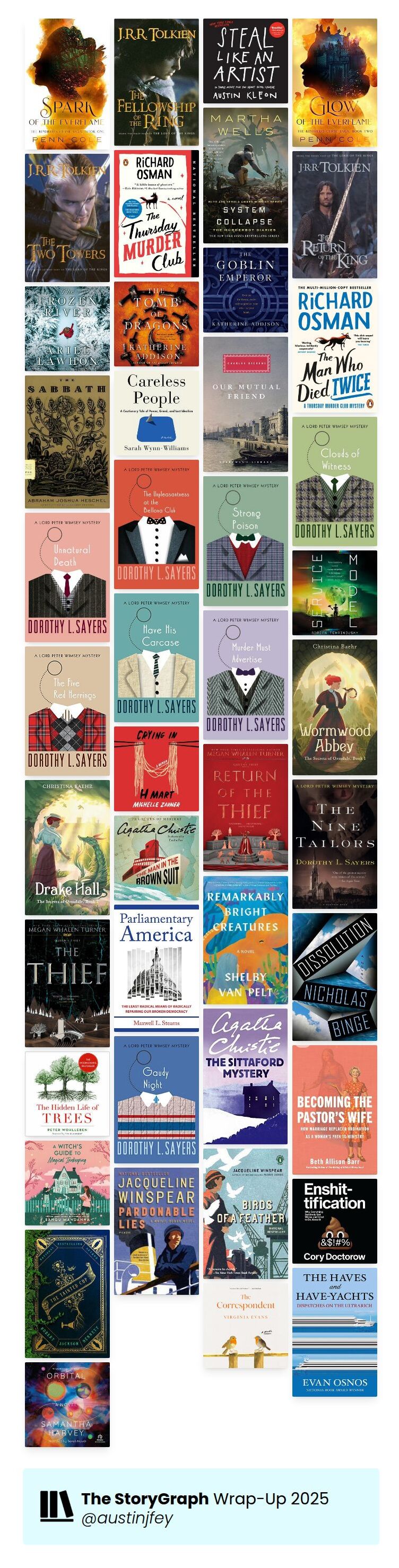
Books Read in September 2025, Part 1

Sorry for the delay getting this out. My scanner was not cooperating, and then I got busy, time passed, and it’s November already! But here are the first two books I read in September, which was an interesting reading month.

Parliamentary America, by Maxwell Stearns 

Published 2024

As a constitutional law professor, Stearns thinks that we are living through a third constitutional crisis (the first when the constitution was written, the second after the Civil War), a crisis that calls for action to repair our democracy and update our founding document for the challenges we face now. 

After laying out the problems of our two party system, especially legislative gridlock and a presidential office which has consolidated power, he takes us on a world tour to examine other forms of democratic governance. Stearns notes that many (most?) of their governments are organized as parliaments with a prime minister and/or president, not like our two houses of congress with a president (even when we have exported democracy, other countries are choosing parliaments instead of our system, which is telling).

Then Stearns proposes three constitutional amendments which would transform our system into a parliamentary system, which he believes would serve us better as a form of government, while still keeping most of the rest of our founding document in place. 

  1. Expand the House of Representatives (to about double its current size), which would mean that each representative would have fewer constituents than they currently have. 
  2. The majority party or parties would select the President (similar to the way that the majority party in, for example, the UK, selects their Prime Minister). 
  3. Give the House the power for a “vote of no confidence” to remove a President who fails to perform their duties (the bar is “maladministration,” which might allow for removal; our current impeachment method clearly is not working; the bar is set too high). 

Is amending our Constitution to transform into a more Parliamentary form of government radical? Yes, but also, as Stearns takes us through the world tour of democracies, he notes that pretty much all other democratic nations have some sort of Parliament.

I would love to see some dramatic reform like this, though how feasible it is is anyone’s guess. 

Our current system, however, is failing us. Stearns says (and I agree with him) that our current system has locked us into having only two parties, and those parties tend to pull to the extremes. We’re also in an era of extreme Presidential power. Power has been consolidated to the Executive branch at the expense of the other branches of government (and, I think, at the expense of the American people). 

Stearns says the political unhappiness of many Americans is feeling unrepresented in Congress, and as we are seeing in Trump’s second term, Congressional Republicans have ceded much (most?) of their independence to Trump anyway. Stearns posits that many Americans have more moderate political views, and that a multi-party Parliamentary system would allow more viewpoints to be represented, and would also allow coalition-building and incentivize moderation and compromise to get things done in government. 

I agree that his system sounds much more functional, but what I don’t know is if we have the political will to push dramatic changes through. Our government is currently being dismantled as quickly as the Trump administration is able to do so, which may give us an opportunity to rebuild something different (assuming we make it to the other side of this administration with our democracy intact). However, I think it will take some real political leadership and a strong push to make something like this happen. I am very interested in the idea of Constitutional reform, and I would love to have more viable parties to represent political interests (two parties are clearly insufficient for the task with a population of ~340 million). 

I have so many more thoughts on this and our current political situation, but those probably belong in a separate essay. For the purposes of this review, I think the ideas are interesting, I like that someone is out there with some bold suggestions for how we move forward out of our current malaise and the death spiral we currently seem to be locked in, and I hope that this sparks conversations and actual action to move us forward as a functioning 21st century country. One of my biggest complaints is that we have real issues to address and clearly a government that is not interested in addressing most of them. Our current Congress seems mostly uninterested in governing, and even if you think that government should mostly leave people alone, I think that most of us could find some agreement on a few issues where government is what we need to address some collective issues. Our current leaders mostly do not seem interested in tackling issues like adults, and I really want some adult people to work together to help us move forward. I’d love to talk about this book or other ideas! If you have read it, I’d love to hear your thoughts! 

The Sittaford Mystery, by Agatha Christie 

Published 1931 

Apparently this was originally published with the title “The Murder at Hazlemoor,” and I am really not sure why it was changed. Either title sounds equally interesting to me personally, but I’m also not a 1930’s publishing house. 

This is another Christie novel without including one of her best-known detectives. It is a standalone and I don’t believe any of the characters show up in other books. 

Mrs. Willet and her daughter Violet are renting a large country house in the winter (which everyone finds odd), and one evening they host a séance in which a “spirit” tells them that their landlord, Captain Trevelyan is dead. 

One of the Captain’s old friends, Major Burnaby, is alarmed and says he will go on foot (the roads being impassible due to snow) to check on his friend. He discovers (of course) that the Captain has been murdered! 

A police Inspector Narracot investigates the crime, and a young and extremely capable young lady, Emily Trefusis, also investigates on behalf of her fiancé, a nephew of the murdered man (an heir and a suspect). 

While I did not particularly enjoy the last standalone Christie I read (The Man in the Brown Suit), this is a more straightforward mystery which I did enjoy. There are the usual red herrings, people behaving suspiciously, people suspecting and trying to shield one another from suspicion (and therefore being stupid), and a clever murderer who was not quite as clever as our detectives. 

This makes the book sound formulaic, and in some ways it is, but I enjoyed it as a classic Christie novel that is fun and a worthwhile read.

Books Read in August 2025, part 2

Dissolution, by Nicholas Binge

Published 2025

Maggie is eighty-three years old and her husband, Stanley, is in a memory care facility called Sunrise because he has dementia. Sometimes he remembers Maggie, and sometimes he doesn’t. 

The story opens with Maggie in a strange interview with someone named Hassan who tells her that actually the problem is that Stanley isn’t forgetting things, his memories are being taken from him. Hassan needs some information from Stanley’s mind to help him stop some baddies who are erasing Stanley, and he needs Maggie’s help to get into Stanley’s mind to retrieve the information before it is too late. 

The story unfolds in the present and the past, delving into Stanley’s early life for the seeds of his discoveries about time travel via memories. It also chronicles Stanley and Maggie’s life story and their deep love for one another. But as Maggie goes deeper into her journey through Stanley’s mind, it becomes clear that Stanley is hiding things, even from her. 

Time travel and memory are also a little mind-bending subjects, and this was a fun ride as well as a sweet love story. The stakes do get raised to “oh no this could affect the world in bad ways if we aren’t careful,” but it does not get to the “and now we’re in a complete dystopia” level that it would if this was a Blake Crouch novel. 

That said, if you enjoy Crouch, you will likely enjoy this novel, and it also avoids some of the annoying time travel tropes while making use of some others. It just depends on what annoys you about time travel if you’ve read other books in the genre! 

The Hidden Life of Trees, by Peter Wohlleben

Published 2015

Written by a German forest manager, this book is designed to evoke wonder and delight around forests and trees. Wohlleben describes trees in extremely anthropomorphic ways which I found overblown or slightly distracting at times, but I also appreciate the technical knowledge he has about tree communication and the ways that trees compete and cooperate. 

Overall I found the book delightful, and while I imagine I might have been irritated by the ways the author describes some trees as “street kids” and “immigrants,” as a lay person some of the analogies were helpful. 

Trees are pretty amazing, and I appreciate that someone is out there trying to convince people that forests are great and we should allow more forested areas to thrive on their own without our intervention and without trying to make all land “productive” for human purposes (even the language of “productive” and “unproductive” creates a value judgment that isn’t helpful). 

Part of being a good steward as a human is caring for the beautiful planet we call home, not simply stripping it for parts, and living more with nature instead of opposed to it, is an interesting topic of much discussion and debate. I loved learning more about networks of trees that make up a forest, how they coexist with other organisms, and how trees work to create a beautiful ecosystem from which we all benefit. 

Books Read in August 2025, part 1

The Man in the Brown Suit, by Agatha Christie

Published 1924

Anne Beddingfield is at a loose end after the death of her father, an impecunious academic. She goes to London to look for work and adventure, and one day witnesses a man’s death at a Tube station (London’s underground train transport system). 

She decides to investigate, and this leads to her taking a cabin on a ship sailing for South Africa to find out more about the man’s death, which she thinks may also be connected to another death in a country house. Shenanigans ensue, of course. 

The spine of this book said it was first in the “Colonel Race” mysteries by Christie, and Colonel Race is a character in this book, but not in the way Poirot or Miss Marple are the main detectives in their stories. Miss Beddingfield is the main character in the book, and it’s a standalone story in which Col. Race appears as a background character. 

I appreciate that Christie was experimenting with style here—after two Poirot mysteries and a Tommy & Tuppence mystery, she moved on to try something else. However, I am not sure this effort at a thriller was completely successful. 

Anne is interesting, but she is attracted to men who are a bit brutal and harsh. She rejects a man who respects and admires her and instead is interested in someone who yells at her and orders her around. This preference was off-putting and I understand why this has not made any “best of” lists. There is a lot of Agatha Christie material out there, and I recommend starting elsewhere (The Murder of Roger Ackroyd, Death on the Nile, And Then There Were None, and The Body in the Library, and Murder on the Orient Express are well known for a reason. I also have a soft spot for Dumb Witness—a cute dog! and Crooked House—if you want to try something not related to Poirot or Marple). 

Remarkably Bright Creatures, by Shelby Van Pelt

Published 2022

Despite opening from the point of view of Marcellus, a Giant Pacific Octopus who lives in an aquarium, this is not a sci fi book. All the other point-of-view characters are humans living normal human lives. 

The primary characters are Tova, a lonely older woman who cleans the aquarium and befriends Marcellus, and Cameron, a young man who can’t seem to hold a steady job and who is searching for his identity and some stability to escape his troubled past. 

Tova is considering retiring and moving to a retirement home as she has no one to care for her as she ages—she’s a widow whose only son tragically died many years ago when he was just eighteen. She is so focused on her lack of biological family that she overlooks the people already in her life. 

Cameron also thinks of his past as his destiny. His drug-addicted mother left him with his aunt and never told him who his father was. Cameron finds his father’s class ring and goes to search for someone to tell him who he is. 

Of course, eventually Tova and Cameron meet at the aquarium, and Marcellus helps them realize that their pasts may hold tragedy, but they can move forward together. 

While I occasionally wanted to shake some sense into the characters (especially Cameron), this was a sweet book about connection and identity and I enjoyed it. 

Books Read in June 2025

I made it through my 6-hour exam (hooray!), so I now turn my attention back to books I have read somewhat recently.

Unnatural Death, by Dorothy Sayers

Published 1927

At dinner one evening, Lord Peter Wimsey chats with a doctor who suspects that one of his patients was murdered, though he cannot prove it. She was an elderly woman with terminal cancer, so it is not unusual that she died, but in the doctor’s opinion it is unusual that she died so soon and suddenly near the end of the previous year. 

His speaking up caused a lot of fuss and led to his needing to move out of the area due to bad feeling against him in the village. Lord Peter decides to investigate, despite the doctor’s protests (wanting to leave well enough alone). 

More suspicious deaths assure Lord Peter that he is on the track of an unscrupulous killer, but with the murder method being extremely difficult to trace, it is a challenge for him to prove the connection. 

Another good mystery from Dorothy Sayers and an opportunity to spend time with the erudite Lord Peter and his friends. 

The Unpleasantness at the Bellona Club, by Dorothy Sayers

Published 1928

On Armistice Day, 90-year-old General Fentiman is found dead in the titular gentlemen’s club. He has been in poor health, so this is not unexpected, but there is something slightly strange about his body that Lord Peter notices. 

It is also reported that the General’s sister, Lady Dormer, died at almost the exact same time. Lady Dormer’s will leaves everything either to her brother, or, if her brother predeceases her, she leaves everything to her companion. 

It becomes important to establish who actually died first, and Lord Peter takes the case to establish if both deaths were natural and who predeceased whom. 

Another interesting mystery from Dorothy Sayers, and I also appreciated that it also addresses the internal psychological wounds that soldiers brought back from war. Lord Peter himself has what might be mild PTSD, and one of the General’s grandsons has major physical and psychological wounds from being exposed to chemical weapons. This makes his behavior seem more “suspicious,” and whether that means he is guilty of a crime or just suffering from the effects is unclear. These wounds affect all his relationships, from his relationship with his wife to his difficulty in holding a steady job, and I appreciated having this acknowledged though with a fairly light touch as part of the story. 

Strong Poison, by Dorothy Sayers

Published 1930

A young woman, Harriet Vane, is on trial for the murder (by poisoning, as the title suggests) of her ex-boyfriend. Lord Peter, attending the trial, is immediately struck by her and cannot believe that she is guilty. 

The jury cannot come to a verdict, so there is a delay while a new jury is selected and a new trial can begin. Lord Peter takes this chance to re-investigate the case in hopes that he can discover Miss Vane’s innocence…and possibly marry her after her acquittal. 

Unfortunately for Lord Peter, the case and Miss Vane both prove tricky. Discovering new evidence and even another motive for the crime is difficult, and Miss Vane, while not repulsed by Lord Peter, is not in a marrying frame of mind (being in prison and on trial). 

The introduction of Harriet Vane to the Lord Peter mysteries is a bright spot and a turning point for the detective’s character development. While the story does not end with them together (which I appreciate), it does end with her being freed from false accusation and the audience is interested to see what happens next.

Service Model, by Adrian Tchaikovsky

Published 2024

In a post-apocalyptic setting, a robot valet named Charles serves his elderly master faithfully day after day…until one day he murders him. 

Charles leaves his manor house and sets out toward the central robot Diagnostics facility so they can figure out what made him slit his master’s throat and solve the problem so Charles (now un-Charles, as he had to leave his name behind at the manor) can find other employment. 

As we follow un-Charles on his adventures, it becomes clear that civilization has completely collapsed and it is unclear if there are any humans left for un-Charles to serve, or if robots are all that remain as relics of time gone by. The robots un-Charles encounters are all trying to complete their programmed missions as efficiently as possible. Of course they don’t have feelings about the futility of trying to do all their human-centric jobs when there are no humans to benefit from these jobs, but if they did, they might be depressed.

Un-Charles, despite his one murderous episode, is a gentle narrator, which helps to lighten a pretty bleak landscape. He does make a friend, the Wonk, who accompanies him on many of his adventures, and who pushes un-Charles to be more than the sum of his programmed parts. 

This book gives a sharp critique of late-stage capitalism and joins many other works of art warning about over-reliance upon technology and its dehumanizing effects (as usual, it leads to the collapse of civilization). It is interesting and Tchaikovsky is an engaging writer, but it is certainly a cautionary tale and not just interesting science fiction. 

(Sorry for the dark cover image–the painting was very light so I needed to adjust it, but the results were not completely satisfactory.)

The Five Red Herrings, by Dorothy Sayers

Published 1931

Lord Peter, on holiday in Scotland in an artistic community, consults with the local police on the case of an artist found dead among the rocks. While initially thought to have fallen to his death while painting, Lord Peter finds evidence that all is not as it seems, and murder is indicated. 

This painter seemed to have provoked quarrels with basically every other artist in the area, so there is no shortage of suspects. 

I have slightly mixed feelings about this installment of Lord Peter’s adventures in detection because while the story is interesting, there is a lot (and I mean a lot) of discussion about railway timetables, and all the Scottish characters’ dialogue is written out phonetically, so we get the idea of what the Scottish brogue sounds like. 

This is charming for a few paragraphs, and then becomes difficult when it is clear that this will persist throughout the entire book. 

Between struggling through some of the dialogue and also not having personal familiarity with the British obsession with railway timetables, this one was a bit more difficult. I also could not stop thinking about the Monty Python railway timetable sketch, which I will link here in case you have not watched it. 

Not a bad mystery, but I would not put it in my top-tier list of Lord Peter’s adventures. 

Books Read in May 2025

Sorry this is so late! I have been studying hard for the CERTIFIED FINANCIAL PLANNER® exam, which I am sitting for in July, so other efforts have fallen by the wayside. However, here are two books I finished in May:

Our Mutual Friend, by Charles Dickens

Published 1865

I have been making my meandering way through the works of Dickens over the past few years, and I found a copy of this one at our local library book sale (which is amazing and not to be missed!) last year. This was one of Dickens’ last novels, and he does seem to start with a bit more confidence than some of his earlier works. 

As with some other Dickens novels, the central story involves money: a will and a large inheritance (I haven’t read Bleak House yet, but look forward to it!). The only son of the late Mr. Harmon is set to inherit a large fortune if he returns to England and marries the girl his father chose for him, Bella Wilfur. Miss Wilfur captured the old gentleman’s attention as a child, and he wanted his son to marry her when they both grew up (this is bananas, but was it maybe less bananas in the 19th century? Unclear). 

The son, John Harmon, was abroad and is apparently murdered immediately upon returning to England, alas. So instead, the Boffins, faithful servants of old Mr. Harmon inherit the goods. 

Separately, we also follow the story of Lizzie Hexam, whose father pulled Harmon’s body out of the Thames, and we also check in on some Members of Society who are around I presume to be a contrast to the lower class characters. 

Class and money are two defining themes of the novel, with various characters exemplifying different attitudes toward both. Their moral character is not defined by their rising or falling in status or class, which is interesting, though we do have the satisfaction of seeing some bad characters come to bad ends. 

As with all Dickens novels, you have to settle in and go at his pace. You can’t rush forward, and you have to bear with all the side-plots and cast of many characters who appear and weave in and out of the story. Eventually most of the threads come together in some way, but it is sometimes a long road to get there. 

While there were sub-plots and characters I enjoyed, this is not going on my list as a “top shelf” Dickens. It wasn’t bad, but I was bored in the sections where the fancy society people came together and tried to all trick each other into thinking they were richer than they were, and I also did not care for the way the main male character “tested the character” of the main female character. Lying to a woman you profess to love to see if she will pass your test and demanding she be loyal to you no matter what is not great. Either you think she has good moral character or you don’t. Do not lie to her and get other people to also lie to her to trick her into being “good.” 

All in all, I would say this is a Dickens novel you could skip unless you’re really a completionist. There are, as always, entertaining side characters, and I thought the various characters and their attitudes toward money (or the lack thereof) were helpful in some ways, but Dickens explored those themes in other books to greater success I think. 

Clouds of Witness, by Dorothy Sayers

Published 1926

I am an unabashed Dorothy Sayers fan. This is the second book in her Lord Peter Wimsey detective series. In it, Lord Peter’s brother, Gerald, is on trial for murdering his sister’s fiancé, and Lord Peter (with his faithful valet, Bunter, and police friend, Inspector Parker) must unravel the mystery. 

As usual in a good mystery, witnesses are lying about their movements the night of the murder, there are various clues to be followed up, and in this case there is also a vivid scene of blundering about near a bog in the foggy moors. 

The mystery is good, the characters are entertaining, and I appreciate the literary quotations and references. 

Lord Peter is an interesting sleuth because while he is methodical in following clues, personable in questioning witnesses, and can come across as the idiotic upper class rich gentleman to lull suspects into a false sense of security, we also see glimpses of his sensitive emotions and hints of the ways that a generation of men who went off to WWI did not escape unscathed. This blend humanizes him. Bunter’s obvious faithfulness to his master, without being slavish, is also a point in his favor. 

This was perfect to read in the evenings to wind down while I am studying for the CFP® exam—I can’t handle putting other facts in my brain with nonfiction right now (my brain is full of facts about financial planning!), but I didn’t want something completely mindless, so a good story well told was exactly what I needed.