I made it through my 6-hour exam (hooray!), so I now turn my attention back to books I have read somewhat recently.
Unnatural Death, by Dorothy Sayers
Published 1927

At dinner one evening, Lord Peter Wimsey chats with a doctor who suspects that one of his patients was murdered, though he cannot prove it. She was an elderly woman with terminal cancer, so it is not unusual that she died, but in the doctor’s opinion it is unusual that she died so soon and suddenly near the end of the previous year.
His speaking up caused a lot of fuss and led to his needing to move out of the area due to bad feeling against him in the village. Lord Peter decides to investigate, despite the doctor’s protests (wanting to leave well enough alone).
More suspicious deaths assure Lord Peter that he is on the track of an unscrupulous killer, but with the murder method being extremely difficult to trace, it is a challenge for him to prove the connection.
Another good mystery from Dorothy Sayers and an opportunity to spend time with the erudite Lord Peter and his friends.
The Unpleasantness at the Bellona Club, by Dorothy Sayers
Published 1928

On Armistice Day, 90-year-old General Fentiman is found dead in the titular gentlemen’s club. He has been in poor health, so this is not unexpected, but there is something slightly strange about his body that Lord Peter notices.
It is also reported that the General’s sister, Lady Dormer, died at almost the exact same time. Lady Dormer’s will leaves everything either to her brother, or, if her brother predeceases her, she leaves everything to her companion.
It becomes important to establish who actually died first, and Lord Peter takes the case to establish if both deaths were natural and who predeceased whom.
Another interesting mystery from Dorothy Sayers, and I also appreciated that it also addresses the internal psychological wounds that soldiers brought back from war. Lord Peter himself has what might be mild PTSD, and one of the General’s grandsons has major physical and psychological wounds from being exposed to chemical weapons. This makes his behavior seem more “suspicious,” and whether that means he is guilty of a crime or just suffering from the effects is unclear. These wounds affect all his relationships, from his relationship with his wife to his difficulty in holding a steady job, and I appreciated having this acknowledged though with a fairly light touch as part of the story.
Strong Poison, by Dorothy Sayers
Published 1930

A young woman, Harriet Vane, is on trial for the murder (by poisoning, as the title suggests) of her ex-boyfriend. Lord Peter, attending the trial, is immediately struck by her and cannot believe that she is guilty.
The jury cannot come to a verdict, so there is a delay while a new jury is selected and a new trial can begin. Lord Peter takes this chance to re-investigate the case in hopes that he can discover Miss Vane’s innocence…and possibly marry her after her acquittal.
Unfortunately for Lord Peter, the case and Miss Vane both prove tricky. Discovering new evidence and even another motive for the crime is difficult, and Miss Vane, while not repulsed by Lord Peter, is not in a marrying frame of mind (being in prison and on trial).
The introduction of Harriet Vane to the Lord Peter mysteries is a bright spot and a turning point for the detective’s character development. While the story does not end with them together (which I appreciate), it does end with her being freed from false accusation and the audience is interested to see what happens next.
Service Model, by Adrian Tchaikovsky

Published 2024
In a post-apocalyptic setting, a robot valet named Charles serves his elderly master faithfully day after day…until one day he murders him.
Charles leaves his manor house and sets out toward the central robot Diagnostics facility so they can figure out what made him slit his master’s throat and solve the problem so Charles (now un-Charles, as he had to leave his name behind at the manor) can find other employment.
As we follow un-Charles on his adventures, it becomes clear that civilization has completely collapsed and it is unclear if there are any humans left for un-Charles to serve, or if robots are all that remain as relics of time gone by. The robots un-Charles encounters are all trying to complete their programmed missions as efficiently as possible. Of course they don’t have feelings about the futility of trying to do all their human-centric jobs when there are no humans to benefit from these jobs, but if they did, they might be depressed.
Un-Charles, despite his one murderous episode, is a gentle narrator, which helps to lighten a pretty bleak landscape. He does make a friend, the Wonk, who accompanies him on many of his adventures, and who pushes un-Charles to be more than the sum of his programmed parts.
This book gives a sharp critique of late-stage capitalism and joins many other works of art warning about over-reliance upon technology and its dehumanizing effects (as usual, it leads to the collapse of civilization). It is interesting and Tchaikovsky is an engaging writer, but it is certainly a cautionary tale and not just interesting science fiction.
(Sorry for the dark cover image–the painting was very light so I needed to adjust it, but the results were not completely satisfactory.)
The Five Red Herrings, by Dorothy Sayers
Published 1931
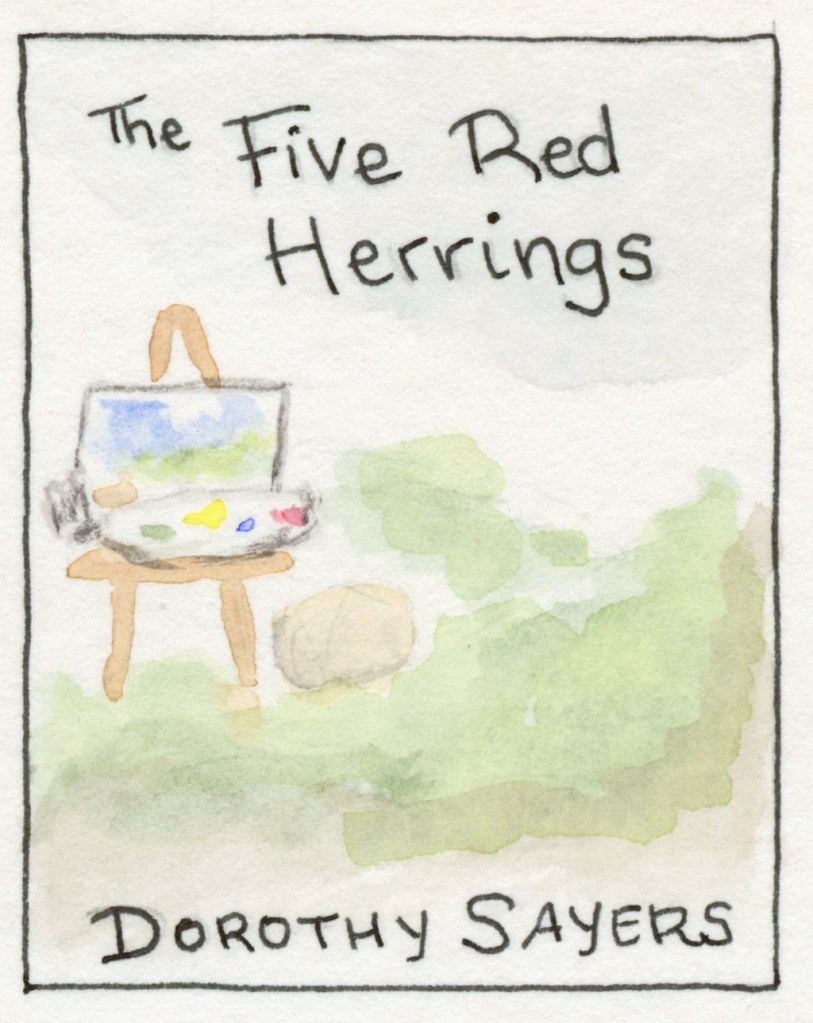
Lord Peter, on holiday in Scotland in an artistic community, consults with the local police on the case of an artist found dead among the rocks. While initially thought to have fallen to his death while painting, Lord Peter finds evidence that all is not as it seems, and murder is indicated.
This painter seemed to have provoked quarrels with basically every other artist in the area, so there is no shortage of suspects.
I have slightly mixed feelings about this installment of Lord Peter’s adventures in detection because while the story is interesting, there is a lot (and I mean a lot) of discussion about railway timetables, and all the Scottish characters’ dialogue is written out phonetically, so we get the idea of what the Scottish brogue sounds like.
This is charming for a few paragraphs, and then becomes difficult when it is clear that this will persist throughout the entire book.
Between struggling through some of the dialogue and also not having personal familiarity with the British obsession with railway timetables, this one was a bit more difficult. I also could not stop thinking about the Monty Python railway timetable sketch, which I will link here in case you have not watched it.
Not a bad mystery, but I would not put it in my top-tier list of Lord Peter’s adventures.



 Once again, I’m embarking on a book reading challenge that I may (or may not–but let’s stay optimistic here!) complete. I’ve read some interesting books this year, but I also want to sprinkle in some more classics, and I want a moderate degree of accountability to read some books on my “I really should get around to reading this–it’s a classic!” list.