2024 Reading Year In Review

Welcome to 2025. 2024 was a difficult year for me personally. My work-life was challenging, I was (and still am) studying for the Certified Financial Planner certification, and there were some other difficult things going on that I’m not going to get into here. 

My reading-for-pleasure life was pretty minimal last year as a result. I did read some good books, and in the fall I read a lot of Agatha Christie, which was lovely and about all I could handle between studying, working, and trying to occasionally hang out with people. 

I did read a lot of words last year, but most of them were for class. Outside of class, I read 23 books last year. 

Top 3 books from 2024: 

“The Kingdom, the Power, and the Glory,” by Tim Alberta. A fascinating look at where and how white evangelicals got to the place they are politically. Alberta is a Christian and a journalist, so he has an interesting perspective. He is pretty clear that he thinks many Christians have exchanged their values for political power. This is nothing new (“Again, the devil took him to a very high mountain and showed him all the kingdoms of the world and their splendor. ‘All this I will give you,’ he said, ‘if you will bow down and worship me.’” -Matthew 4:8-9), it’s just the most recent iteration of this temptation. 

“Ghosted,” by Nancy French. A memoir of someone who has survived a tough life so far, and someone who got on the “wrong side” of right-wing American politics and has seen how vicious it can be. Clearly, this has been a reading theme over the past few years. French is a good writer and great story-teller, and I couldn’t put this down. 

“Middlemarch,” by George Eliot. This book deserves its place in the canon of great works of literature in the English language. It is about life in 19th century England in a small town, full of normal people living their normal lives, but also giving such interior descriptions that you recognize the hopes, fears, actions, inactions of the characters. At its core it looks at three relationships, and peels back layers to see the ways people misunderstand one another and how a good marriage can help you succeed as a human (which may or may not impact you financially, but certainly impacts you morally) and a bad marriage can ruin your life. 

This year, I am still studying, but I’m hoping that I will pass the exam in July and then be free from the burden of study for a while. That should give me some more space to read other things! 

2022 Reading Year In Review

For some unknown reason, I did not click “publish” on this two years ago. Hilarious. Well, here are some great books I read a couple years ago (spoiler from the future: 2023-2024 were also not great reading years, alas).

2022 was a difficult year in many ways, though there were some great bright spots as well (my youngest brother got married!). I slacked off on documenting my reading journey here so hopefully 2023 will be less intense and I will be a little more consistent.

I still read a lot of good books in 2022, and re-read some comfort books. My total count was forty-eight (48) books read, though only two were for my 50 Classics in 5 Years project. Obviously I’m planning to increase that classics-read number this year, and I’m extending my deadline for the project.

I would also like to read more nonfiction this year. I sometimes have a difficult time with nonfiction if the idea was better than the execution, or if the subject matter does not require as many pages as the book possesses. I am open to suggestions for great nonfiction!

Overall, I am pleased with my 2022 reading life. Keeping track of what I am reading has really helped me read more and it has been a good reference for what I read in what year (it’s amazing how quickly I forget what year I read something unless I have a list telling me). I entered most of the books I read in 2022 on Goodreads (though I appear to be missing a few books and decided I’m too lazy to go back and figure it out–I’m going to start fresh in 2023!), and I’m going to try to use it more consistently this year. We will see if that sticks.

Top 10 Books of 2022

Everyone likes a top-ten list, so here is mine for the year:

  1. David Copperfield, by Charles Dickens
  2. The Goblin Emperor, by Katherine Addison
  3. Persuasion, by Jane Austen
  4. Elder Race, by Adrian Tchaikovsky
  5. Death on the Nile, by Agatha Christie
  6. The Golden Enclaves, by Naomi Novik
  7. The Binti novella trilogy, by Nnedi Okorafor
  8. The Relentless Moon, by Mary Robinette Kowal
  9. The Thief, by Megan Whalen Turner
  10. The Murderbot Diaries series, by Martha Wells
  11. Honorable mention: A Wizard’s Guide to Defensive Baking, by T. Kingfisher

If you just wanted the Top Ten list, there you have it, Happy New Year and happy reading. I hope 2023 is a good year of reading excellent and thought-provoking books!

50 Classics in 5 Years Recap and Next Challenge

Greetings, internet! The date of my last entry tells me I have neglected this space for two years. It feels like a garden I have not tended where the grass and clover has overtaken the flower beds, and the whole thing looks a little sad and shabby. So it’s time to clear out some of the weeds, till the soil, and begin again.

In the summer of 2018 I discovered The Classics Club community, which encourages members (membership is quite loose) to read more classics by imposing the structure–a challenge–of reading 50 classics in 5 years. I wanted to include more classics in my reading life, and thought this sounded like a great idea. In August of 2018, I set out to read many classics (to accomplish this in 5 years requires completing 0.833% of a book every month, so a pretty steady pace).

All was going well. And then it was 2020 and all was not going well.

I think it is worthwhile to set goals and read classics. Having a challenge and a list is helpful, especially when a book is finished and it is time to pick up another one. Having a list narrows the choices, which I appreciate.

In reflecting back over my previous challenge, I identified a few things that I might change:

First, I tried to “one up” myself and increase the difficulty by choosing too many long books, and by choosing several sets of multiple books and counting them as one. I modified my list over time and took out some of these books (for example, Kristin Lavransdatter is actually a trilogy. Just because I own an omnibus edition does not mean I have to count it as one!). I am not being graded, nor will I get extra credit for doing more. There’s no need to make this challenge more difficult than it is.

Second, I started this challenge in 2018 and had no idea what the next few years would bring. I did not have the same attention span in 2020 and the couple years after that or the mental space for more challenging reading during the pandemic years.

My first plan to mitigate this was to give myself an extension to 2024, but I was already far behind and 2023 has been difficult for my reading life.

Instead, it is time to close the book on the first 50 Classics Challenge (pun absolutely intended), and start afresh. I hope that the next five years will be a bit better for my reading life, though who knows what lies in store.

This time, I want to be a little kinder to myself and choose some shorter books alongside the classic doorstop novels. I will, of course, choose some unread books from my previous challenge, but include some new titles and not keep everything from my last effort. I will also count books in a series or trilogy as one book each, instead of counting three books as one, etc.

I’m going to go from October 2023 to October 2028, instead of choosing the calendar year, because there are enough things that follow the calendar year, and I want to start while I’m excited for a new project and have a little momentum to start me out on this next adventure.

My list for Round 2 of the challenge is here: https://austinfey.com/50-classics-2/

Of course, I will not be reading only classics. Newer books will make their way onto my list, and I’ll have to decide if I want to review books read in a month or review books as I read them. We shall see. Books read for this challenge will get their own review posts, as usual.

I hope that your reading life is going well and I look forward to rehabilitating my own.

Image from Sergiu Valenas via Unsplash.

August 2021 Books

The Long Way to a Small, Angry Planet, by Becky Chambers (2015)

First, a brief plot summary: a ragtag crew of aliens and humans set out on a journey to a job that is long, possibly a little dangerous, but will pay well. The book is a travelogue, so there are vignettes of their various adventures and we spend time with each of the crew getting to know them and what their species is like. This book though, is less about the plot and more about “hey here are a colorful cast of characters!”

I’ve heard both rave reviews and also complaints about this book, so I expected to love or hate it. I neither loved nor hated it: there were things I enjoyed about this book but more things that didn’t really work for me.

Pros: This is not grimdark sci fi, so if you’re looking for a lighter tone, you might enjoy this. This is a hopeful universe with few true villains and the story doesn’t dwell on the darkness.

There is also great world building where humans are just one race among many intergalactic species—Chambers populates the galaxy with an array of species who are mostly just trying to get along and live their own lives.

Cons: If you like plot-driven stories, this will not be for you. There’s a loose journey, but this is more about the characters’ lives.

The characters, while interesting, seemed a little two-dimensional to me. This could be in part because there are a lot of characters, but no one really made choices that surprised me or were unexpected. And while some situations were a little fraught, everyone nearly always seemed to make the right choice.

For example: one of the ship’s techs is named Kizzy, and if you’ve seen the show Firefly, imagine Kaylee but make her Asian, and that’s Kizzy. She’s pretty much exactly the same, and that annoyed me. She felt completely lifted from that show.

I think that’s my real complaint: other than some interesting worldbuilding, there was nothing about this book that grabbed me. Situations seemed to almost always resolve in the best-case scenario. I don’t need a book to have a lot of unexpected twists, and I’m ok with a book that’s more about character than plot, but this book didn’t delve deeply enough into its characters to show their complexity. It shied away and changed scenes just when something was about to go deep, and conflicts felt too easily resolved.

★ ★ ★

Pride and Prejudice, by Jane Austen (1813)

This was for my 50 Classics project and has its own review here.

★ ★ ★ ★ ★

Project Hail Mary, by Andy Weir (2021)

After loving Weir’s first novel, The Martian, and being disappointed by Weir’s second novel, Artemis, I wasn’t sure what to expect with Project Hail Mary. But the tone of this book is much closer to Weir’s first novel, so I’m glad he went back to a style that suits him better. Part of the problem was, I think, with the female narrator in Artemis. Some authors are not great at writing deeply in the point-of-view of someone of the opposite gender, and Weir does better when he sticks with the male protagonist perspective.

It’s hard to say much about the actual plot of the book without giving things away, but the story opens with a man awakening from a coma, alone, and with no memory of who he is or what he’s supposed to be doing. His memory slowly returns in bits and pieces as he figures out where he is and what his job is, and we get flashbacks as he remembers pieces of what brought him to where he is now.

Thankfully for him, he’s fairly resourceful and intelligent, and while not knowing who he is for some time is frightening, he makes the most of opportunities for scientific research.

I enjoyed the unfolding story style, though the book takes an unexpected turn partway through which is definitely a spoiler to discuss, but if you’ve read the book I’d love to know what you thought!

While there are lots of similarities to Weir’s first book, I enjoy his style, so if you enjoyed The Martian’s snarky yet exceedingly resourceful character, you’ll probably enjoy Project Hail Mary.

★ ★ ★ ★

Ok, I’m leaving some space to say a little more about the plot, but it’s spoilery, so if you don’t want to know, click away now…

…more spoiler space…

…yet more space, because space is vast…

…almost there…

Ok. So partway through the book, our protagonist, Ryland Grace, has first contact with an intelligent alien, whom he dubs Rocky. I thought Weir did a pretty good job of keeping the book grounded while introducing alien life, and I enjoyed the ways that Rocky and Grace learned to communicate despite their huge differences. Both are scientists who are trying to save their worlds, and that curiosity and desperation brings them together.

I did not see the twist of meeting an alien coming at all–I expected the book to be more like The Martian where our lone protagonist had to solve the problems himself, so I enjoyed the two working together to figure out how to save both their worlds. Did I think it was slightly contrived that both space ships only had one survivor by the time they got to the Tau Ceti system? Yes. But I’m ok with that because I thought Weir executed the story well.
Pride and Prejudice Review

It is a truth universally acknowledged that a review of Jane Austen’s work is superfluous. Yet here I am anyway.

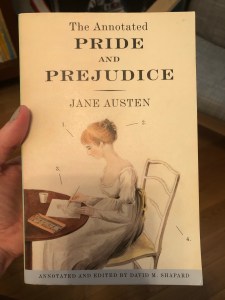
Pride & Prejudice book cover

This is one of my all-time favorite books. From my first reading as a teenager, taking extended “bathroom breaks” to read the small hardback with tiny print which I hid under the sink for such occasions (sorry, Mom!), I fell in love with Austen’s wit and style, her characters, and her well-paced story.

Published in 1813 and popular from the beginning, there is plenty of scholarship out there if you are interested in that. And it’s so well known that I don’t know that I can add much here but if for some reason you’d like a refresher, here’s a summary:

Mr. & Mrs. Bennet live in a village in Hertfordshire with their five daughters. They are not poor, but having no male heir and not being frugal, the daughters will have to rely on marrying well for future economic stability.

The novel opens with the arrival of two handsome and eligible bachelors to the neighborhood: Mr. Bingley (sweet and outgoing) and Mr. Darcy (introverted and has some…pride). The story follows the shenanigans of Mrs. Bennet’s attempts to marry off her daughters and how that works out for them all.

The Bennets’ second daughter, Elizabeth, is the protagonist of the novel, and she is active, energetic, outgoing, smart, and witty—and also opinionated and believes strongly in first impressions (so she can be…prejudiced). She is a fun character to follow, and she goes through a lot of growth by the novel’s end.

The characters are so well-drawn and the comic characters are both pretty great and ridiculous (but also can be dangerous and/or disappointing to their families). The book balances getting to know the many characters with a good bit of plot–we don’t sit around too long before the next event, and I appreciate that she keeps everything moving.

This book is rightly considered a classic, but I think it’s pretty approachable as well. While there are details like the entail of the Bennet property and other manners that can be confusing to the modern reader, the plot moves along and the characters are interesting that parts of it feel fairly modern. While the 19th century was a while ago and manners have changed, people are still people–that has not changed.

★ ★ ★ ★ ★