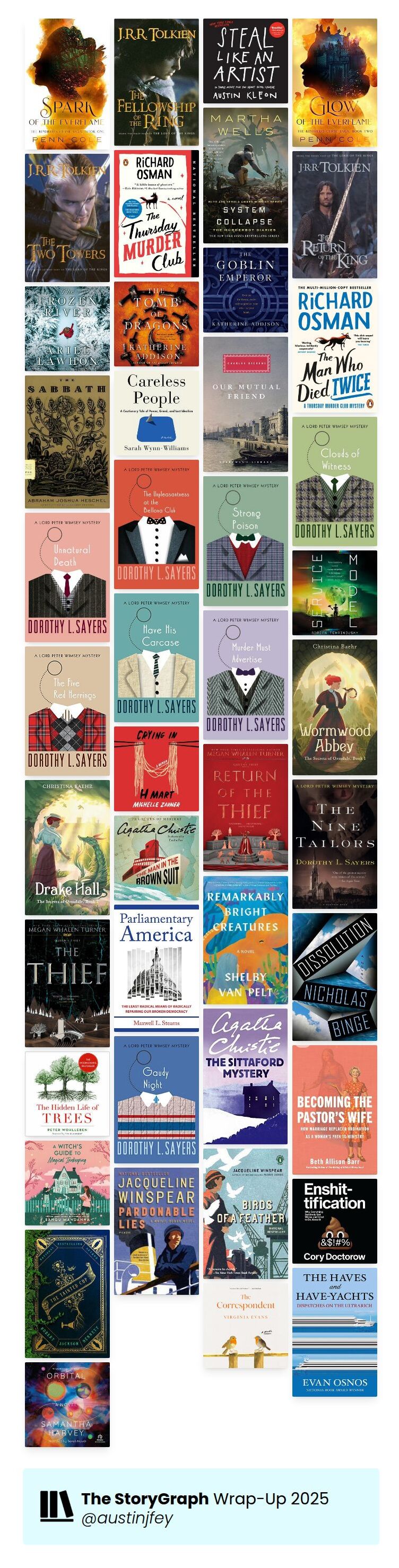
2025 Reading Year in Review (and Best Books)

Quitting my full-time job and studying for (and passing!) the CFP® exam meant I had more time last year to read books. Finishing my two-year study journey meant I finally had more capacity to read non-fiction (previously, my non-fiction brain slot was taken up with reading about tax, estate, retirement, insurance, investment, and general financial planning).

I read some non-fiction bangers this year, many of them on themes of politics, wealth, society, technology, and how these impact our lives. 

I also read a lot of mysteries last year to wind down while studying in the first half of the year, and read a mixture of other fiction over the year. 

I finished 45 books last year, and while I fell off a bit on the blog with my month-in-review posts in the fall (which was busier than anticipated and also I got sick a couple times; I have drafts and will go back and publish these later), I feel pretty satisfied with my reading life. Of course, I would like to continue to push back against the machines and spend a little more time reading, so that’s a 2026 reading resolution, but I’m excited to keep reading this year! 

Choosing superlative “best” books of the year is a little fraught, but it’s helpful for me to look over what I read last year and see what stuck with me. Keeping track of my reading helps me remember what I have actually read, and helps the themes, characters, prose, and ideas stick with me more than just reading and immediately moving on from a reading experience. I don’t want to just consume books mindlessly; I want books to be a part of me in a real way, and I want to be in conversation with them. 

So here are my Top 10 from 2025:

  1. Enshittification, by Cory Doctorow 
  2. The Sabbath, by Abraham Joshua Heschel
  3. The Correspondent, by Virginia Evans 
  4. Careless People, by Sarah Wynn Williams
  5. The Thursday Murder Club, by Richard Osman
  6. Crying in H Mart, by Michelle Zauner 
  7. Dissolution, by Nicholas Binge
  8. The Tainted Cup, by Robert Jackson Bennett 
  9. Parliamentary America, by Maxwell Stearns 
  10. The Haves and Have Yachts, by Evan Osnos 

Honorable Mentions: The Lord of the Rings, by J.R.R. Tolkien; The Goblin Emperor, by Katherine Addison; The Thief, by Megan Whalen Turner; and Gaudy Night, by Dorothy Sayers. These are honorable mentions because they are all re-reads of books that I love, and I really enjoyed them once again, I just wanted to give a chance to some new-to-me books. 

What were your favorite books of 2025? What are you looking forward to in 2026? Any book resolutions? 
The Fellowship of the Ring Review

J. R. R. Tolkien published this book in 1954, and his imagination has fascinated several generations of readers.

“‘I am not made for perilous quests. I wish I had never seen the Ring! Why did it come to me? Why was I chosen?’ [cried Frodo].” 

“‘Such questions cannot be answered,’ said Gandalf. ‘You may be sure that it was not for any merit that others do not possess: not for power or wisdom, at any rate. But you have been chosen, and you must therefore use such strength and heart and wits as you have.’”

Tolkien’s epic adventure is a classic for a reason. 

Frodo Baggins is a peace-loving hobbit who is bequeathed a magic ring of enormous power, which brings danger to him and his closest friends. He must embark on a quest to rid the world of the evil the powerful ring and its master are wreaking on Middle Earth. 

Tolkien’s Middle Earth is the gold standard by which future high fantasy is measured. His imagination was incredible, and his attention to the detail of the world makes it feel so real. The pace is slower and the journey meanders in a way that does not feel quite modern, but the characters are interesting, the world fascinating, and Tolkien’s descriptive language is beautiful. He obviously cares about trees and growing things, and his best characters blend love of earth and love of people, while the villains despoil landscape and culture.

Some readers will be annoyed by digressions into Shire life and the strangeness of Tom Bombadil, wanting to get on with the quest, while other readers are inspired to write fan fiction about them. 

The themes of this story, of good vs. evil, of fascinating creatures and a complex and beautiful world, make it enduring. 

“‘But the only measure that [Sauron] knows is desire, desire for power; and so he judges all hearts. Into his heart the thought will not enter that any will refuse it, that having the Ring we may seek to destroy it.’” 

We all bring our own perspectives to any reading, and the (long) chapter “The Council of Elrond” is a great example of arguments about what to do with something that could give you great power. There is wisdom here for our current time. 

There isn’t really anything new I can say about this book, but it was so fun to revisit Middle Earth after a few years. There were many delightful details I had forgotten. For example, after Bilbo’s party where he disappears and leaves the ring to Frodo, seventeen years pass before Frodo leaves the Shire at Gandalf’s urging, to take the ring away to a safer location. Also, if you have never read the bit about Bilbo leaving pointed gifts to his various neighbors and relations, that section is hilarious (he leaves stationery to someone who never writes back; he leaves an umbrella to someone who always borrows from others, etc.). It is a great little portrait of the joys and trials of ordinary life. 

I listed to the audio version read by Andy Serkis, and his commitment to the story and the characters is impressive and immersive. He sings all the songs and his character voices are distinct. What a joy to hear.

I look forward to continuing the adventure in The Two Towers.

★ ★ ★ ★ ★

Books Read in January 2025

After a slower year of reading in 2024 (due to taking classes + work stress), I am hoping to read more this year. Here are the four books I read and finished in January:

Spark of the Everflame, by Penn Cole

Published 2024.

This is a fantasy romance book that I’d call it a “popcorn” book: fun to read, interesting magic system, plot-focused, fairly two-dimensional characters, not necessarily a book future generations will read. I enjoyed it, but I do not anticipate revisiting it. An entertaining story, but nothing profound. That is ok—I needed something light hearted while I had a lot of feelings around quitting my job of the past fourteen years. 

Our protagonist, Diem, is a young woman who lives in a world where there are Mortals and Descended, who are magic-wielders. The Descended rule over the mortals, and try to protect their bloodline and therefore their magic and power. Diem has grown up as a scrappy mortal who works both as a healer and also knows fighting tactics because this is a fantasy adventure book. Her mother warned her against the Descended, but after her mother disappears, Diem helps as a palace healer and meets a handsome broody prince (which could be tricky since she has a childhood sweetheart…), and Mortal/Descended fighting shenanigans ensue. 

The magic and world building structure was interesting and kept me reading even when I rolled my eyes a little bit at the love triangle and some of the pretty obvious plot points. 

The Fellowship of the Ring, by J. R. R. Tolkien

Published 1954.

This is also a fantasy book, but is very different in style and tone! I read for my 50 Classics challenge, which I’m basically resurrecting this year, as I didn’t read many classics last year (well, except I read a bunch of Agatha Christie books in the fall–those are definitely classic mysteries, so…partial credit to me). It will get its own post. 

Steal Like an Artist, by Austin Kleon

Published 2012.

This little book is full of encouragement and good advice for being creative. It is specifically geared toward people who are artists and/or identify as “creative,” but really, it’s excellent advice for everyone (the author agrees and says there are many ways of being creative, many of which are not explicitly labeled as such). 

I really appreciated the advice about not necessarily making art a job, especially when starting out. Obviously, I support anyone who wants to be a full-time artist! But for many of us, that is putting too high a burden on our creativity, and having a job to pay the bills and allow creative outlets on the side is a good way to balance our lives (she says while currently on a sabbatical…but my plan is to find a day job eventually once I’ve caught my breath, recovered, and figured out what I want to do next). 

Glow of the Everflame, by Penn Cole

Published 2024.

Book two of the Everflame series (quadrilogy? I’m not convinced that’s a word but it’s a four-book series). 

It’s hard to review a subsequent book without spoilers for the first book, but the journey of our plucky heroine continues. In book one, she was completely on the side of the mortals, but in book two, she meets more of the descended and realizes that they are also people who do not deserve to die. Many of them just don’t know about the misery of the mortals, and they aren’t all evil, just sheltered. 

The love triangle continues to be annoying, mostly because it’s pretty clear that Diem likes one more than the other, and also that guy is committed to protecting her, while the other guy is pretty flaky. But the author committed to the triangle, so the drama continues. 

I want to find out what happens and learn more about the other realms and their magic, so I plan to continue the series, but I’m much less invested in the romantic plot than the world building. 

2022 Reading Year In Review

For some unknown reason, I did not click “publish” on this two years ago. Hilarious. Well, here are some great books I read a couple years ago (spoiler from the future: 2023-2024 were also not great reading years, alas).

2022 was a difficult year in many ways, though there were some great bright spots as well (my youngest brother got married!). I slacked off on documenting my reading journey here so hopefully 2023 will be less intense and I will be a little more consistent.

I still read a lot of good books in 2022, and re-read some comfort books. My total count was forty-eight (48) books read, though only two were for my 50 Classics in 5 Years project. Obviously I’m planning to increase that classics-read number this year, and I’m extending my deadline for the project.

I would also like to read more nonfiction this year. I sometimes have a difficult time with nonfiction if the idea was better than the execution, or if the subject matter does not require as many pages as the book possesses. I am open to suggestions for great nonfiction!

Overall, I am pleased with my 2022 reading life. Keeping track of what I am reading has really helped me read more and it has been a good reference for what I read in what year (it’s amazing how quickly I forget what year I read something unless I have a list telling me). I entered most of the books I read in 2022 on Goodreads (though I appear to be missing a few books and decided I’m too lazy to go back and figure it out–I’m going to start fresh in 2023!), and I’m going to try to use it more consistently this year. We will see if that sticks.

Top 10 Books of 2022

Everyone likes a top-ten list, so here is mine for the year:

  1. David Copperfield, by Charles Dickens
  2. The Goblin Emperor, by Katherine Addison
  3. Persuasion, by Jane Austen
  4. Elder Race, by Adrian Tchaikovsky
  5. Death on the Nile, by Agatha Christie
  6. The Golden Enclaves, by Naomi Novik
  7. The Binti novella trilogy, by Nnedi Okorafor
  8. The Relentless Moon, by Mary Robinette Kowal
  9. The Thief, by Megan Whalen Turner
  10. The Murderbot Diaries series, by Martha Wells
  11. Honorable mention: A Wizard’s Guide to Defensive Baking, by T. Kingfisher

If you just wanted the Top Ten list, there you have it, Happy New Year and happy reading. I hope 2023 is a good year of reading excellent and thought-provoking books!

January 2021 Books Read

The Ladies of Grace Adieu and Other Stories, by Susanna Clarke (2006)

When I mentioned that I was having trouble focusing on anything long, my friend Maggie suggested this book of short stories, which turned out to be perfect for the end of December and beginning of January. I finished 2/3 of the stories in December, but since I finished it this month, it counts as the first read for 2021!

These stories were delightful forays back into the world introduced in Jonathan Strange and Mr. Norrell. They all take place in Clarke’s alternate-nineteenth century, full of the twisty magic that was part of that book. Mr. Strange even makes an appearance in one of the stories. If you liked Jonathan Strange & Mr. Norrell, you’ll enjoy these stories.

These stories a great side-adventures, and feel like they would not be out of place in a collection of Grimm’s fairy tales. The stories also feature more female magicians, who were overlooked by Strange and Norrell, and I enjoyed them very much.

Two of my favorites were “John Uksglass and the Cumbrian Charcoal Burner”, and “Mrs. Mabb.” The first story is about the king getting a comeuppance (somewhat accidentally) from a lowly charcoal burner who feels himself injured by the king’s thoughtlessness, with entertaining result.

Mrs. Mabb is about a young woman determined not to give her suitor up to the titular fairy’s attentions. It’s suitably tricky and sometimes hilarious to figure out how to defeat a fairy antagonist.

Great fun, and a great way to kick off the new year.

★ ★ ★ ★

The Priory of the Orange Tree, by Samantha Shannon (2019)

I started a conversation with my husband this way, “I haven’t read Game of Thrones, but…” and he laughed, which was fair. Since I haven’t read Martin’s tomes, it’s probably unfair to compare this to those books, except that I know those books are fantasy with political maneuvering, and this book is also high fantasy with kingdoms, political machinations, magic, and yes, dragons (two types of dragons, and the water dragons have human riders).

The most evil fire dragon, The Nameless One, is prophesied to rise again, a thousand years after he was defeated, and the disparate human kingdoms and queendoms of the world must unite to stop him before he destroys them all.

As with some high fantasy, especially fantasy heavy on plot, there is not as much about characters’ inner lives, and some characters are more well-drawn than others. There are four perspective characters whose adventures we follow: Ead at the court of Inys, Tané in her quest to become a dragon rider, Niclays as he tries to claw his way back to his home and relevance, and Lord Arteloth as he (somewhat haplessly) wanders about, connecting threads.

Of the four, Ead was my favorite and felt the most fleshed-out. We start the story with her at court as she rises in influence and seeks to hide her true nature and mission from Queen Sabran (another interesting character).

In many fantasy stories, the heroes are mostly men with women as love interests or guides, and only occasionally adventurers in their own right, so I appreciated that Shannon’s world was populated with powerful women—queens, mages, warriors, schemers, pirates, and courtiers.

As this book is quite long, there were places where it dragged a bit, and it took a while to really kick into high gear, and Niclays Roos especially was an annoying character because of his constant self-pity and selfishness. But everyone had a part to play by the end. It’s not super nuanced, but if you like fantasy with political stakes and a world-ending quest, you might enjoy this book.

Content warning: sex, some violence (though not too graphic)

★ ★ ★ ★

Hannah Coulter, by Wendell Berry pic

Hannah Coulter, by Wendell Berry (2004)

While I’ve read a few essays and some poetry by Wendell Berry, I’ve somehow missed reading any of his novels. I got Hannah Coulter for Christmas, and started in on it. As expected, the writing was beautiful and spare, and the story was very human.

Hannah Coulter narrates the story of her life, reflecting on her 70+ years and its joys and sorrows. In some ways, it was a low-stakes book, as the characters are all ordinary people living in ordinary times, but in other ways it reminded me that we are all making choices and setting the course of our lives one moment at a time, and that ordinary lives are beautiful too.

Hannah reflects on her marriages (she’s now twice-widowed) and her children, her community, and the land she’s been farming and which has supported her in its own way. They cared for the land and the land cared for them. And living a “slower” and “smaller” life has kept her more connected to who she is, tethered in a way she fears her children are not.

I look forward to reading more of Berry’s novels—if you have suggestions of which one to read next let me know!

★ ★ ★ ★