Anne Beddingfield is at a loose end after the death of her father, an impecunious academic. She goes to London to look for work and adventure, and one day witnesses a man’s death at a Tube station (London’s underground train transport system).
She decides to investigate, and this leads to her taking a cabin on a ship sailing for South Africa to find out more about the man’s death, which she thinks may also be connected to another death in a country house. Shenanigans ensue, of course.
The spine of this book said it was first in the “Colonel Race” mysteries by Christie, and Colonel Race is a character in this book, but not in the way Poirot or Miss Marple are the main detectives in their stories. Miss Beddingfield is the main character in the book, and it’s a standalone story in which Col. Race appears as a background character.
I appreciate that Christie was experimenting with style here—after two Poirot mysteries and a Tommy & Tuppence mystery, she moved on to try something else. However, I am not sure this effort at a thriller was completely successful.
Anne is interesting, but she is attracted to men who are a bit brutal and harsh. She rejects a man who respects and admires her and instead is interested in someone who yells at her and orders her around. This preference was off-putting and I understand why this has not made any “best of” lists. There is a lot of Agatha Christie material out there, and I recommend starting elsewhere (The Murder of Roger Ackroyd, Death on the Nile, And Then There Were None, and The Body in the Library, and Murder on the Orient Express are well known for a reason. I also have a soft spot for Dumb Witness—a cute dog! and Crooked House—if you want to try something not related to Poirot or Marple).
Remarkably Bright Creatures, by Shelby Van Pelt
Published 2022
Despite opening from the point of view of Marcellus, a Giant Pacific Octopus who lives in an aquarium, this is not a sci fi book. All the other point-of-view characters are humans living normal human lives.
The primary characters are Tova, a lonely older woman who cleans the aquarium and befriends Marcellus, and Cameron, a young man who can’t seem to hold a steady job and who is searching for his identity and some stability to escape his troubled past.
Tova is considering retiring and moving to a retirement home as she has no one to care for her as she ages—she’s a widow whose only son tragically died many years ago when he was just eighteen. She is so focused on her lack of biological family that she overlooks the people already in her life.
Cameron also thinks of his past as his destiny. His drug-addicted mother left him with his aunt and never told him who his father was. Cameron finds his father’s class ring and goes to search for someone to tell him who he is.
Of course, eventually Tova and Cameron meet at the aquarium, and Marcellus helps them realize that their pasts may hold tragedy, but they can move forward together.
While I occasionally wanted to shake some sense into the characters (especially Cameron), this was a sweet book about connection and identity and I enjoyed it.
My book logs tell me that I discovered this series in 2022 and I enjoyed them, but somehow I had missed reading the last installment. Wanting a tale of adventure with a clever plot twist, I returned to the series finale, and was not disappointed.
The Queen’s Thief Series (6 books) is about the political machinations of several small fantasy-Greece-esque countries on a peninsula who are trying to maintain their own sovereignty in the face of larger mainland forces who want to conquer them for their emperor’s own enrichment.
Each book follows a specific point of view character, and in this case it is Pheris, the disabled grandson of an influential baron. Pheris is sent to represent his family at court by his grandfather, under the assumption that the king will send him back to be disposed of. However, the king (used to being underestimated himself) decides to keep Pheris as an attendant, realizing that his physical disabilities have nothing to do with his mental capabilities. Pheris is clever and observant, and it is interesting to see the story unfold from his perspective.
With the final book in a series, you’re always hoping that the author sticks the landing, because it could either bring the story to a satisfying conclusion or be a stumble that taints the entire project. In this case, I am happy to say that I liked the ending, and I enjoyed this visit with familiar and new characters.
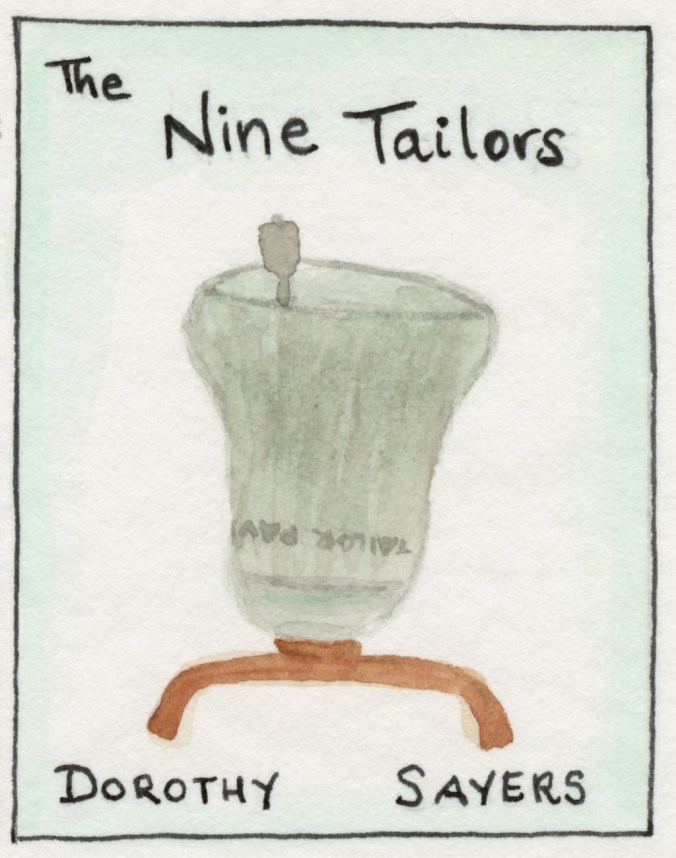
The Nine Tailors, by Dorothy Sayers
Published 1934
A couple books after Lord Peter’s railway timetable adventures comes Lord Peter’s church-bell-ringing adventure.
After really enjoying “Have His Carcase” and “Murder Must Advertise,” I have to say that this is not a favorite installment of Sayers’ mysteries. This one has a lot of information about English bell-ringing, which is a bit abstruse. Thankfully even if I didn’t follow everything that was happening with the bells, the rest of the mystery to discover the identity of an extra body found in a grave and who the killer might be was easier to follow.
Lord Peter and his faithful valet Bunter are smart as ever, and there were still things to enjoy, even if I found the bell ringing descriptions confusing and sometimes a little tedious. I didn’t race through this one like I did the previous book, but it was still fine enough that I wanted to see what happened at the end.
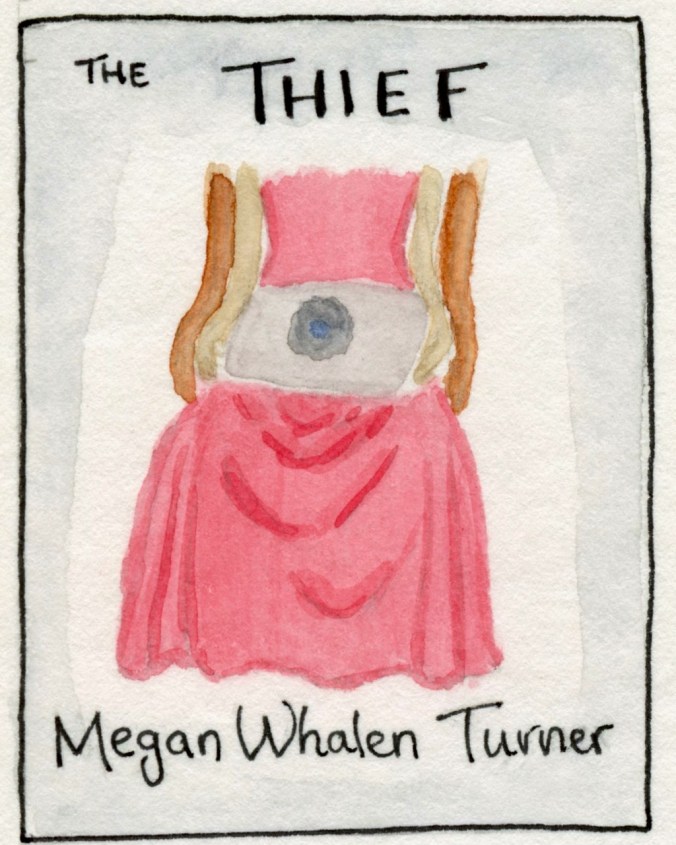
The Thief, by Megan Whalen Turner
Published 1996
After reading the conclusion of the series, I went back and re-read the first installment. The point of view character in this story is Gen, a thief who has stolen a ring from the king of Sounis, boasted of his skill, and been locked in the king’s prison as a result. One day he is freed by the king’s magus and brought on an adventure because the king requires his skills to steal something else.
This is an adventure story that starts slowly as Gen and his companions start their journey toward whatever it is that Gen is supposed to steal for the king. About halfway through the book though, things start really happening, and the pace and the stakes keep ratcheting up to a twist and a satisfying conclusion.
I don’t want to say too much, as part of what I enjoyed about this book was the journey and the surprises. This is an engaging story with likable characters, and I enjoy Greek-myth-adjacent stories (technically this is a fantasy world, not ancient Greece, but… these people are pretty clearly Greek).
It was interesting to re-read after knowing what happens and where the series goes after this book. Each subsequent book deepens the characters and the political machinations that are only barely touched in this first story. A fine beginning to a YA series I enjoyed (it is a Newberry Honor book, so clearly others have enjoyed it as well).
In this installment, Lord Peter goes undercover as an employee at a London Advertising Agency. One of the agency’s employees has fallen down a stairwell to his death, and the man in charge is not sure if it was accidental or not. Lord Peter quickly discovers that there is a link between the firm and a drug dealing operation and must use his wits and his working-class man disguise to get to the bottom of the murder and the drug ring.
The agency had strong Mad Men vibes; just change the time period to the early 1930’s with slightly less alcohol (slightly). The office culture feels creative and chaotic, with different departments getting in each other’s way and with the petty rivalries that accompany most office dramas.
It’s a different setting for Lord Peter, which was a nice change of pace, and I enjoyed this installment more than the previous Scottish artist installment.
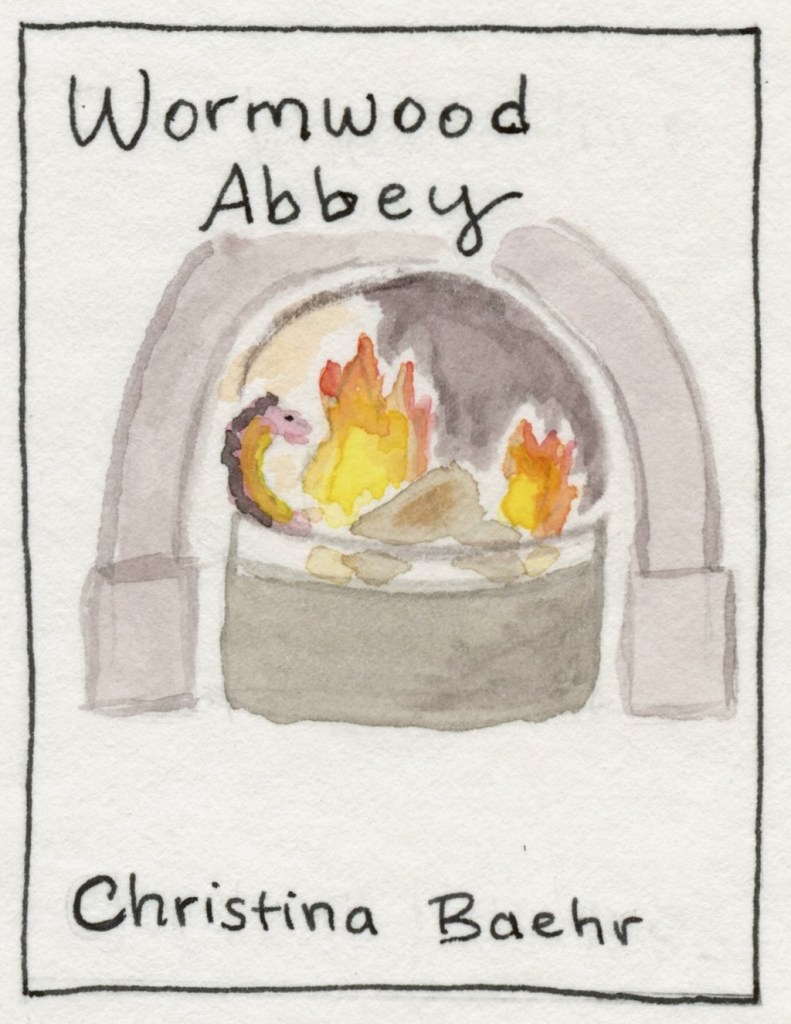
Wormwood Abbey and Drake Hall, by Christina Baehr
Published 2023, 2024
My Mom recommended this YA series “The Secrets of Ormdale” as a“wind down before bed when you’re stressed out from studying” read, and they definitely worked for that purpose!
Edith Worms and her family relocate to her father’s ancestral home in northern England when his brother and nephew are killed and he inherits the estate (it’s 1899 and therefore preposterous to think that her female cousin might inherit).
The house and her cousin are somewhat dark and dour, clearly hiding secrets from Edith and her family. The attractive young man from the neighboring estate seems to be in on the secrets as well, and Edith has to unravel what is going on and also why they are so keen to keep these secrets from the outside world. There may be dragons involved….
I would describe these (and the author similarly describes them) as “cozy, light gothic vibes” books (do not fear: tea is served at regular intervals). They are fast-paced, appropriate for middle grade readers, and each book is pretty short (there are 5 in the series). Each subsequent book picks up right where the previous book leaves off. These are not earth-shattering, but are entertaining; Victorian England + dragons is a fun combination, and the author clearly set her book in this time period to give nods to classic 19th century British authors. I am not sure if I will continue the series, but twelve-year-old me probably would have enjoyed them, and while there are some darker topics hinted at, they are handled with a light age-appropriate touch.
Crying in H Mart, by Michelle Zauner
Published 2021
There are times in our lives that are important milestones for looking back, for contemplating our lives and relationships, and reinterpreting them in light of what we have learned. There are things that are part of me at age 39 that I couldn’t have adequately explained or known at age 29.
Memoirs are a way of recontextualizing our lives, of telling a story about who we are and how we got there. Here Michelle Zauner explores her complicated relationship with her mother after her mother’s death from cancer.
It is a way of honoring her mother and her own journey, and a way of trying to tell the truth about who her mother was and work through her emotions and judgments now that her mother is gone. Food was a central way her mother showed her love for her daughter and for the people around her, which is something I love: food is such a central part of being human and the food of one’s childhood is especially powerful. Zauner’s descriptions of Korean food made me immediately want to head to my nearest Korean restaurant and order one of everything, and it also made me think about some of the food of my childhood and the meals my family ate that are such a part of me—food can be a time travel device to memories and cooking can be therapy.
I enjoy learning about people and about food, so this was in a great intersection for me. It is also about reflecting on the death of a parent, so just know going in that it will be both mouth-watering and also tear-inducing. Kind of like life.
My husband pointed out that while I have read multiple memoirs over the past few years, they are all memoirs written by women. Maybe I need to expand my memoir range–if you have any suggestions written by men, I am open to those! Especially if they have descriptions of food.
I made it through my 6-hour exam (hooray!), so I now turn my attention back to books I have read somewhat recently.
Unnatural Death, by Dorothy Sayers
Published 1927
At dinner one evening, Lord Peter Wimsey chats with a doctor who suspects that one of his patients was murdered, though he cannot prove it. She was an elderly woman with terminal cancer, so it is not unusual that she died, but in the doctor’s opinion it is unusual that she died so soon and suddenly near the end of the previous year.
His speaking up caused a lot of fuss and led to his needing to move out of the area due to bad feeling against him in the village. Lord Peter decides to investigate, despite the doctor’s protests (wanting to leave well enough alone).
More suspicious deaths assure Lord Peter that he is on the track of an unscrupulous killer, but with the murder method being extremely difficult to trace, it is a challenge for him to prove the connection.
Another good mystery from Dorothy Sayers and an opportunity to spend time with the erudite Lord Peter and his friends.
The Unpleasantness at the Bellona Club, by Dorothy Sayers
Published 1928
On Armistice Day, 90-year-old General Fentiman is found dead in the titular gentlemen’s club. He has been in poor health, so this is not unexpected, but there is something slightly strange about his body that Lord Peter notices.
It is also reported that the General’s sister, Lady Dormer, died at almost the exact same time. Lady Dormer’s will leaves everything either to her brother, or, if her brother predeceases her, she leaves everything to her companion.
It becomes important to establish who actually died first, and Lord Peter takes the case to establish if both deaths were natural and who predeceased whom.
Another interesting mystery from Dorothy Sayers, and I also appreciated that it also addresses the internal psychological wounds that soldiers brought back from war. Lord Peter himself has what might be mild PTSD, and one of the General’s grandsons has major physical and psychological wounds from being exposed to chemical weapons. This makes his behavior seem more “suspicious,” and whether that means he is guilty of a crime or just suffering from the effects is unclear. These wounds affect all his relationships, from his relationship with his wife to his difficulty in holding a steady job, and I appreciated having this acknowledged though with a fairly light touch as part of the story.
Strong Poison, by Dorothy Sayers
Published 1930
A young woman, Harriet Vane, is on trial for the murder (by poisoning, as the title suggests) of her ex-boyfriend. Lord Peter, attending the trial, is immediately struck by her and cannot believe that she is guilty.
The jury cannot come to a verdict, so there is a delay while a new jury is selected and a new trial can begin. Lord Peter takes this chance to re-investigate the case in hopes that he can discover Miss Vane’s innocence…and possibly marry her after her acquittal.
Unfortunately for Lord Peter, the case and Miss Vane both prove tricky. Discovering new evidence and even another motive for the crime is difficult, and Miss Vane, while not repulsed by Lord Peter, is not in a marrying frame of mind (being in prison and on trial).
The introduction of Harriet Vane to the Lord Peter mysteries is a bright spot and a turning point for the detective’s character development. While the story does not end with them together (which I appreciate), it does end with her being freed from false accusation and the audience is interested to see what happens next.
Service Model, by Adrian Tchaikovsky
Published 2024
In a post-apocalyptic setting, a robot valet named Charles serves his elderly master faithfully day after day…until one day he murders him.
Charles leaves his manor house and sets out toward the central robot Diagnostics facility so they can figure out what made him slit his master’s throat and solve the problem so Charles (now un-Charles, as he had to leave his name behind at the manor) can find other employment.
As we follow un-Charles on his adventures, it becomes clear that civilization has completely collapsed and it is unclear if there are any humans left for un-Charles to serve, or if robots are all that remain as relics of time gone by. The robots un-Charles encounters are all trying to complete their programmed missions as efficiently as possible. Of course they don’t have feelings about the futility of trying to do all their human-centric jobs when there are no humans to benefit from these jobs, but if they did, they might be depressed.
Un-Charles, despite his one murderous episode, is a gentle narrator, which helps to lighten a pretty bleak landscape. He does make a friend, the Wonk, who accompanies him on many of his adventures, and who pushes un-Charles to be more than the sum of his programmed parts.
This book gives a sharp critique of late-stage capitalism and joins many other works of art warning about over-reliance upon technology and its dehumanizing effects (as usual, it leads to the collapse of civilization). It is interesting and Tchaikovsky is an engaging writer, but it is certainly a cautionary tale and not just interesting science fiction.
(Sorry for the dark cover image–the painting was very light so I needed to adjust it, but the results were not completely satisfactory.)
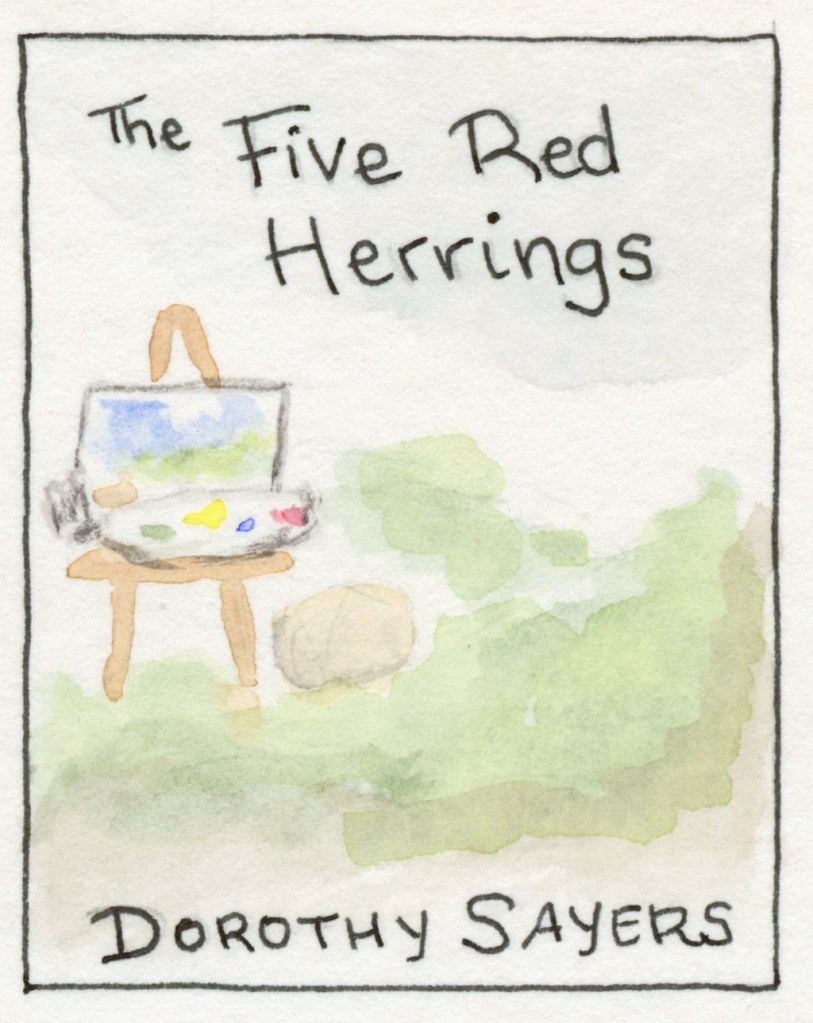
The Five Red Herrings, by Dorothy Sayers
Published 1931
Lord Peter, on holiday in Scotland in an artistic community, consults with the local police on the case of an artist found dead among the rocks. While initially thought to have fallen to his death while painting, Lord Peter finds evidence that all is not as it seems, and murder is indicated.
This painter seemed to have provoked quarrels with basically every other artist in the area, so there is no shortage of suspects.
I have slightly mixed feelings about this installment of Lord Peter’s adventures in detection because while the story is interesting, there is a lot (and I mean a lot) of discussion about railway timetables, and all the Scottish characters’ dialogue is written out phonetically, so we get the idea of what the Scottish brogue sounds like.
This is charming for a few paragraphs, and then becomes difficult when it is clear that this will persist throughout the entire book.
Between struggling through some of the dialogue and also not having personal familiarity with the British obsession with railway timetables, this one was a bit more difficult. I also could not stop thinking about the Monty Python railway timetable sketch, which I will link here in case you have not watched it.
Not a bad mystery, but I would not put it in my top-tier list of Lord Peter’s adventures.
Sorry this is so late! I have been studying hard for the CERTIFIED FINANCIAL PLANNER® exam, which I am sitting for in July, so other efforts have fallen by the wayside. However, here are two books I finished in May:
Our Mutual Friend, by Charles Dickens
Published 1865
I have been making my meandering way through the works of Dickens over the past few years, and I found a copy of this one at our local library book sale (which is amazing and not to be missed!) last year. This was one of Dickens’ last novels, and he does seem to start with a bit more confidence than some of his earlier works.
As with some other Dickens novels, the central story involves money: a will and a large inheritance (I haven’t read Bleak House yet, but look forward to it!). The only son of the late Mr. Harmon is set to inherit a large fortune if he returns to England and marries the girl his father chose for him, Bella Wilfur. Miss Wilfur captured the old gentleman’s attention as a child, and he wanted his son to marry her when they both grew up (this is bananas, but was it maybe less bananas in the 19th century? Unclear).
The son, John Harmon, was abroad and is apparently murdered immediately upon returning to England, alas. So instead, the Boffins, faithful servants of old Mr. Harmon inherit the goods.
Separately, we also follow the story of Lizzie Hexam, whose father pulled Harmon’s body out of the Thames, and we also check in on some Members of Society who are around I presume to be a contrast to the lower class characters.
Class and money are two defining themes of the novel, with various characters exemplifying different attitudes toward both. Their moral character is not defined by their rising or falling in status or class, which is interesting, though we do have the satisfaction of seeing some bad characters come to bad ends.
As with all Dickens novels, you have to settle in and go at his pace. You can’t rush forward, and you have to bear with all the side-plots and cast of many characters who appear and weave in and out of the story. Eventually most of the threads come together in some way, but it is sometimes a long road to get there.
While there were sub-plots and characters I enjoyed, this is not going on my list as a “top shelf” Dickens. It wasn’t bad, but I was bored in the sections where the fancy society people came together and tried to all trick each other into thinking they were richer than they were, and I also did not care for the way the main male character “tested the character” of the main female character. Lying to a woman you profess to love to see if she will pass your test and demanding she be loyal to you no matter what is not great. Either you think she has good moral character or you don’t. Do not lie to her and get other people to also lie to her to trick her into being “good.”
All in all, I would say this is a Dickens novel you could skip unless you’re really a completionist. There are, as always, entertaining side characters, and I thought the various characters and their attitudes toward money (or the lack thereof) were helpful in some ways, but Dickens explored those themes in other books to greater success I think.
Clouds of Witness, by Dorothy Sayers
Published 1926
I am an unabashed Dorothy Sayers fan. This is the second book in her Lord Peter Wimsey detective series. In it, Lord Peter’s brother, Gerald, is on trial for murdering his sister’s fiancé, and Lord Peter (with his faithful valet, Bunter, and police friend, Inspector Parker) must unravel the mystery.
As usual in a good mystery, witnesses are lying about their movements the night of the murder, there are various clues to be followed up, and in this case there is also a vivid scene of blundering about near a bog in the foggy moors.
The mystery is good, the characters are entertaining, and I appreciate the literary quotations and references.
Lord Peter is an interesting sleuth because while he is methodical in following clues, personable in questioning witnesses, and can come across as the idiotic upper class rich gentleman to lull suspects into a false sense of security, we also see glimpses of his sensitive emotions and hints of the ways that a generation of men who went off to WWI did not escape unscathed. This blend humanizes him. Bunter’s obvious faithfulness to his master, without being slavish, is also a point in his favor.
This was perfect to read in the evenings to wind down while I am studying for the CFP® exam—I can’t handle putting other facts in my brain with nonfiction right now (my brain is full of facts about financial planning!), but I didn’t want something completely mindless, so a good story well told was exactly what I needed.