Sorry for the delay getting this out. My scanner was not cooperating, and then I got busy, time passed, and it’s November already! But here are the first two books I read in September, which was an interesting reading month.
Parliamentary America, by Maxwell Stearns
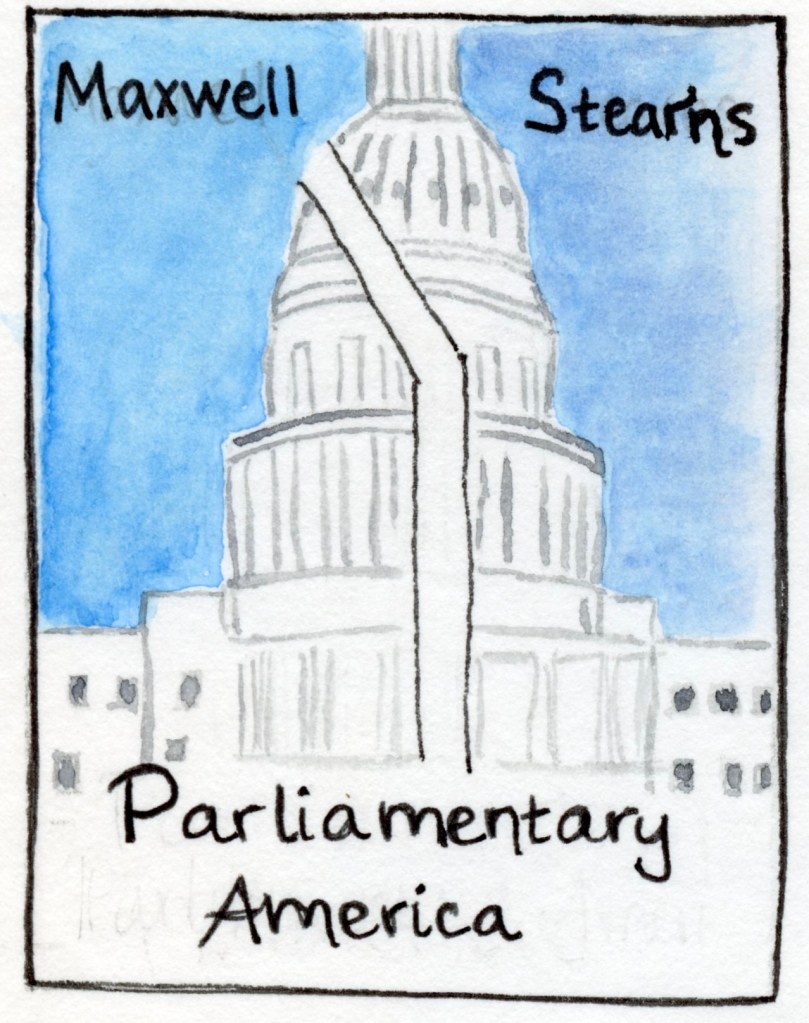
Published 2024
As a constitutional law professor, Stearns thinks that we are living through a third constitutional crisis (the first when the constitution was written, the second after the Civil War), a crisis that calls for action to repair our democracy and update our founding document for the challenges we face now.
After laying out the problems of our two party system, especially legislative gridlock and a presidential office which has consolidated power, he takes us on a world tour to examine other forms of democratic governance. Stearns notes that many (most?) of their governments are organized as parliaments with a prime minister and/or president, not like our two houses of congress with a president (even when we have exported democracy, other countries are choosing parliaments instead of our system, which is telling).
Then Stearns proposes three constitutional amendments which would transform our system into a parliamentary system, which he believes would serve us better as a form of government, while still keeping most of the rest of our founding document in place.
- Expand the House of Representatives (to about double its current size), which would mean that each representative would have fewer constituents than they currently have.
- The majority party or parties would select the President (similar to the way that the majority party in, for example, the UK, selects their Prime Minister).
- Give the House the power for a “vote of no confidence” to remove a President who fails to perform their duties (the bar is “maladministration,” which might allow for removal; our current impeachment method clearly is not working; the bar is set too high).
Is amending our Constitution to transform into a more Parliamentary form of government radical? Yes, but also, as Stearns takes us through the world tour of democracies, he notes that pretty much all other democratic nations have some sort of Parliament.
I would love to see some dramatic reform like this, though how feasible it is is anyone’s guess.
Our current system, however, is failing us. Stearns says (and I agree with him) that our current system has locked us into having only two parties, and those parties tend to pull to the extremes. We’re also in an era of extreme Presidential power. Power has been consolidated to the Executive branch at the expense of the other branches of government (and, I think, at the expense of the American people).
Stearns says the political unhappiness of many Americans is feeling unrepresented in Congress, and as we are seeing in Trump’s second term, Congressional Republicans have ceded much (most?) of their independence to Trump anyway. Stearns posits that many Americans have more moderate political views, and that a multi-party Parliamentary system would allow more viewpoints to be represented, and would also allow coalition-building and incentivize moderation and compromise to get things done in government.
I agree that his system sounds much more functional, but what I don’t know is if we have the political will to push dramatic changes through. Our government is currently being dismantled as quickly as the Trump administration is able to do so, which may give us an opportunity to rebuild something different (assuming we make it to the other side of this administration with our democracy intact). However, I think it will take some real political leadership and a strong push to make something like this happen. I am very interested in the idea of Constitutional reform, and I would love to have more viable parties to represent political interests (two parties are clearly insufficient for the task with a population of ~340 million).
I have so many more thoughts on this and our current political situation, but those probably belong in a separate essay. For the purposes of this review, I think the ideas are interesting, I like that someone is out there with some bold suggestions for how we move forward out of our current malaise and the death spiral we currently seem to be locked in, and I hope that this sparks conversations and actual action to move us forward as a functioning 21st century country. One of my biggest complaints is that we have real issues to address and clearly a government that is not interested in addressing most of them. Our current Congress seems mostly uninterested in governing, and even if you think that government should mostly leave people alone, I think that most of us could find some agreement on a few issues where government is what we need to address some collective issues. Our current leaders mostly do not seem interested in tackling issues like adults, and I really want some adult people to work together to help us move forward. I’d love to talk about this book or other ideas! If you have read it, I’d love to hear your thoughts!
The Sittaford Mystery, by Agatha Christie
Published 1931

Apparently this was originally published with the title “The Murder at Hazlemoor,” and I am really not sure why it was changed. Either title sounds equally interesting to me personally, but I’m also not a 1930’s publishing house.
This is another Christie novel without including one of her best-known detectives. It is a standalone and I don’t believe any of the characters show up in other books.
Mrs. Willet and her daughter Violet are renting a large country house in the winter (which everyone finds odd), and one evening they host a séance in which a “spirit” tells them that their landlord, Captain Trevelyan is dead.
One of the Captain’s old friends, Major Burnaby, is alarmed and says he will go on foot (the roads being impassible due to snow) to check on his friend. He discovers (of course) that the Captain has been murdered!
A police Inspector Narracot investigates the crime, and a young and extremely capable young lady, Emily Trefusis, also investigates on behalf of her fiancé, a nephew of the murdered man (an heir and a suspect).
While I did not particularly enjoy the last standalone Christie I read (The Man in the Brown Suit), this is a more straightforward mystery which I did enjoy. There are the usual red herrings, people behaving suspiciously, people suspecting and trying to shield one another from suspicion (and therefore being stupid), and a clever murderer who was not quite as clever as our detectives.
This makes the book sound formulaic, and in some ways it is, but I enjoyed it as a classic Christie novel that is fun and a worthwhile read.
Discover more from Austin Fey
Subscribe to get the latest posts sent to your email.
